
ReasoningBank: How AI Agents Are Learning From Their Own Experience
Discover how ReasoningBank helps AI agents learn from past successes and failures, turning experience into reusable memory for smarter autonomous decisions.
AI agents are getting better at planning, using tools, searching information, and completing multi-step tasks. But there is still a major limitation that becomes obvious when an agent is used repeatedly: making the same mistake more than once. A human who fails at a task usually learns something from that failure and changes their approach the next time. Traditional AI agents often do not work that way. They can complete a difficult task, make several decisions, discover what worked, and then start another task without turning that experience into reusable knowledge. This is exactly the problem that a new research direction called ReasoningBank is trying to address.
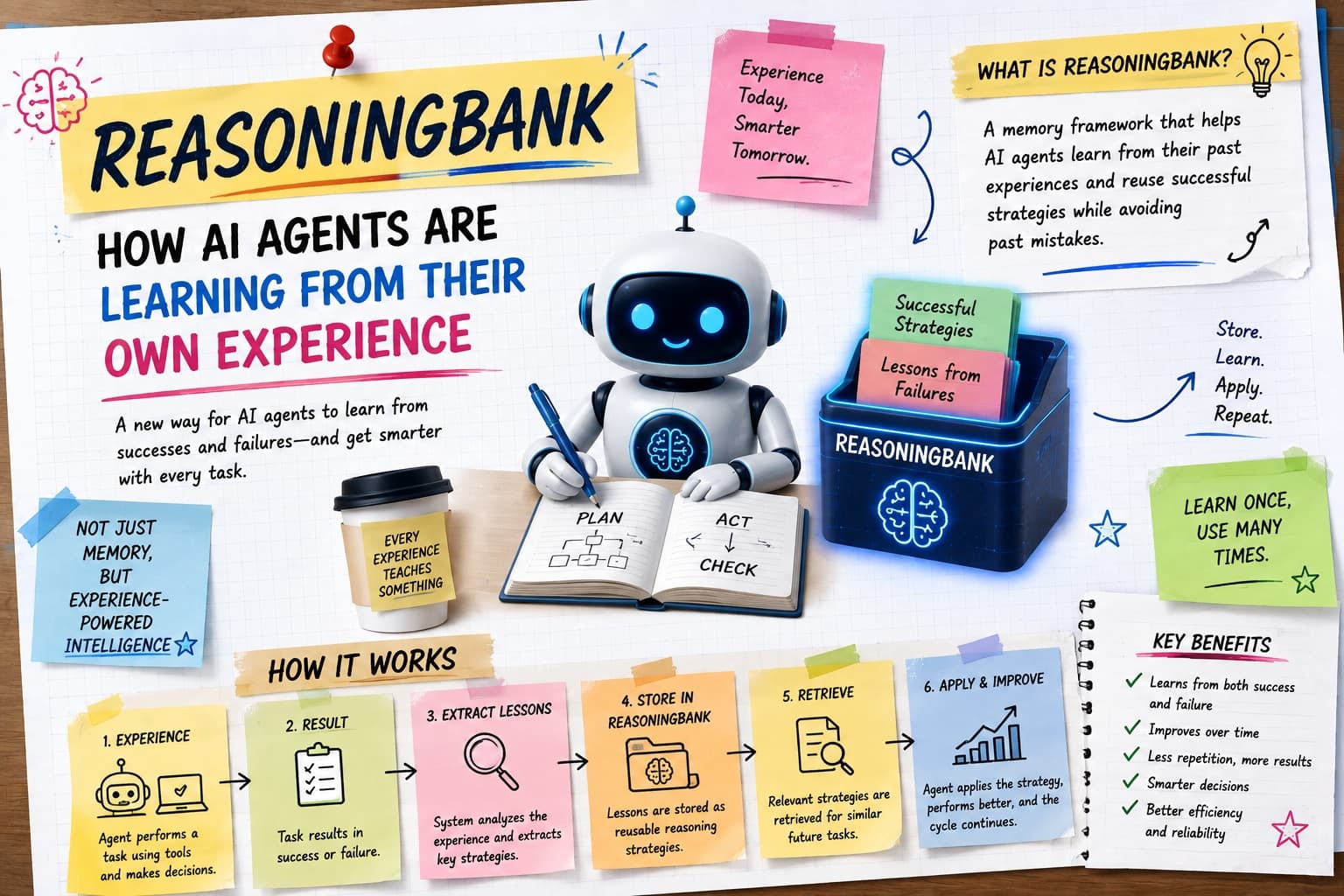
Google Research introduced ReasoningBank in April 2026 as a memory framework designed to help AI agents learn from both successful and failed experiences after deployment. Instead of treating each task as an isolated event, the system extracts general reasoning strategies from previous interactions and makes those strategies available for future tasks. The idea is important because it changes the role of AI memory from simply storing information to storing experience that can improve future decisions.
To understand why this matters, imagine an AI agent that is responsible for navigating websites. During its first few tasks, it may discover that a particular type of website requires opening a menu before a specific button becomes available. Later, the agent encounters a similar task. A normal agent may start exploring from scratch and repeat the same failed attempts. An experience-based memory system could retrieve the previous lesson and immediately apply the strategy that worked before. The agent is not simply remembering a webpage; it is remembering a way of solving a problem.
This is a significant difference from traditional AI Memory. Most memory systems focus on storing facts, conversations, documents, or user preferences. Those forms of memory are useful, but they do not necessarily tell an agent how to act. ReasoningBank takes the idea further by focusing on the strategies an agent can learn from completed tasks. A successful experience can provide a useful pattern, while a failed experience can reveal what should be avoided. Over time, the memory becomes a collection of practical lessons rather than a passive archive.
The concept becomes particularly interesting when an agent operates for a long period. A single interaction may not reveal much about how the agent improves, but hundreds or thousands of tasks can produce a large amount of experience. Some approaches will repeatedly succeed, some will fail under specific conditions, and some will work only when certain tools or environmental conditions are present. A memory system that can identify those patterns can gradually make the agent more efficient without requiring developers to manually write a new rule for every situation.
This is one of the most important ideas behind learning after deployment. Traditionally, improving an AI model meant collecting new training data, modifying the model, running another training cycle, and releasing a new version. That process can be expensive and slow. An experience-based agent memory layer offers a different path. The underlying model can remain the same while the agent becomes more effective by accumulating useful experience externally. Google Research describes ReasoningBank as a framework that enables agents to continuously learn from successes and failures after deployment.
The distinction between model learning and memory learning is worth understanding. When an AI remembers that a user prefers a particular format, that is persistent user memory. When it remembers a document, that is knowledge retrieval. When it remembers that a particular strategy solved a previous problem and applies that strategy to a new problem, that is closer to procedural or reasoning memory. This third type could become especially valuable for autonomous agents because their performance depends not only on what they know, but also on how they approach tasks.
A useful way to picture this system is as an experience loop. The agent receives a goal and performs a task. During execution it observes what happens, chooses actions, uses tools, and eventually reaches either success or failure. Instead of throwing away the execution history, the system analyzes the result and extracts a reusable lesson. That lesson is stored in memory. When another similar task arrives, the agent retrieves relevant lessons before deciding what to do. The new outcome then creates another learning opportunity, allowing the memory to evolve continuously.
This creates a cycle that looks very different from a normal chatbot: experience → evaluation → lesson → memory → retrieval → new action → new experience. The language model remains responsible for reasoning, but the memory layer provides continuity between separate tasks. Over time, the agent can build a practical library of strategies based on what actually happened rather than relying only on knowledge encoded during model training.
One of the most interesting aspects of this approach is that failure becomes useful data. In ordinary applications, a failed task is often treated simply as an error. For an intelligent agent, failure can contain valuable information. Suppose an agent repeatedly chooses a particular tool for a task and discovers that it creates incomplete results. Storing the failure as “this tool does not work” may be too simplistic. A better memory could capture the conditions under which the tool failed, what alternative worked, and why the original strategy was ineffective. That creates a more useful lesson that can be applied selectively to future tasks.
This also creates an opportunity for agents to become more efficient. Without experience memory, the agent may spend many tokens exploring possible approaches every time it encounters a familiar problem. With reusable strategies, it can start closer to a successful solution. The result could be lower reasoning cost, fewer unnecessary tool calls, faster task completion, and more consistent outcomes. This is particularly valuable for AI systems that operate at scale, where even small efficiency improvements become significant across millions of interactions.
ReasoningBank is also part of a wider movement toward agentic memory. Google Research reported other 2026 work showing increasing interest in memory systems that actively manage experience rather than simply retrieving text. At Google I/O 2026, research teams described broader progress toward an agentic era, including systems where multiple agents can build software and operate through extended workflows.
This trend suggests that AI Memory is becoming less about “remembering facts” and more about building an internal history of interaction with the world. For example, an AI coding agent could eventually remember that a certain deployment strategy failed on one infrastructure setup, that a particular debugging sequence solved a recurring problem, and that a specific repository requires additional validation before making changes. Those memories are much more actionable than a simple summary of the previous conversation.
However, experience-based memory also introduces difficult challenges. Not every successful action represents a good strategy, and not every failure should be remembered forever. An agent might accidentally succeed because of unusual circumstances. A temporary failure may occur because an external API was unavailable rather than because the reasoning strategy was wrong. If the memory system stores everything without evaluation, it can accumulate misleading lessons and eventually make the agent worse. This means the memory layer needs its own evaluation process. Before an experience becomes a reusable lesson, the system should consider whether the result was reliable, whether the lesson generalizes to similar tasks, and under what conditions it should be applied. Confidence, relevance, source, task similarity, and historical success rate can all become important signals when deciding whether a memory should influence future reasoning.
Security becomes important here too. If an attacker can manipulate the experiences an agent stores, they may be able to influence future decisions. A malicious webpage, document, tool, or user could potentially create a false lesson that appears useful but actually directs the agent toward an unsafe behavior. This connects experience-based memory directly with the memory-poisoning risks that are becoming increasingly important in agent security.
Another challenge is memory growth. An agent working for months or years could accumulate thousands of strategies. Retrieving all of them for every task would defeat the purpose of efficient memory. The system therefore needs intelligent retrieval and consolidation. Similar lessons may need to be merged, outdated strategies may need to be removed, and highly successful strategies may need to receive stronger priority. This is where vector search, knowledge graphs, summarization, confidence scoring, and memory compression can work together.
The future could involve multiple layers of agent memory operating at the same time. Short-term memory could contain the current task. Long-term semantic memory could contain stable facts and knowledge. Episodic memory could store previous experiences. Procedural memory could store successful strategies. A separate reflection layer could analyze failures and convert them into lessons. The agent would then have something much closer to a structured experience system rather than a simple conversation history.
This could have a major impact on autonomous software development. Imagine an AI coding agent working on hundreds of repositories. Instead of repeatedly discovering the same debugging patterns, it could learn which approaches tend to work for particular architectures. A deployment problem encountered on one project could provide a useful strategy for another. A failed migration could create a warning for future database changes. Over time, the agent's memory becomes a practical engineering knowledge base built from real execution.
The same idea could apply to research agents. A research assistant could learn which search strategies produce high-quality sources, which types of queries tend to return irrelevant information, and which verification methods are most reliable. Instead of simply storing research papers, it would remember how to perform better research.
For business agents, experience memory could improve workflow automation. An agent processing customer requests might learn which workflows usually require human approval, which data sources are most reliable, and which actions frequently result in errors. That experience could help the system make better decisions the next time a similar situation occurs.
What makes this research especially interesting is the possibility of creating self-improving workflows without continuously retraining the foundation model. The language model provides general intelligence, while the memory system provides accumulated experience. This creates a hybrid architecture where the model remains relatively stable but the agent becomes increasingly specialized through interaction.
The long-term implication is bigger than a single framework. AI agents may eventually have something that looks like a personal history of reasoning. They will not only know information; they will know what happened when they tried different approaches. They will understand which strategies worked, which failed, what conditions affected the result, and which lessons should influence future decisions.
This could change how we think about AI intelligence itself. Today, intelligence is often measured by how well a model performs on a benchmark task. But an autonomous agent operates in a changing environment where learning from experience can be just as important as having a high benchmark score. An agent that starts slightly weaker but continuously learns useful strategies may eventually outperform a stronger static system on long-running tasks.
ReasoningBank represents an important step in that direction. By turning successful and failed experiences into reusable reasoning strategies, it moves AI Memory closer to something more dynamic and useful than simple storage.
The future of AI Memory may therefore not be a giant database containing everything an agent has ever seen. It may be a carefully managed system that understands what happened, why it happened, what worked, what failed, and what should be done differently next time.
The next generation of AI agents may not simply remember our conversations. They may remember their own experiences—and use those experiences to become better agents.