LangGraph: The AI Agent Framework Powering Stateful and Intelligent Workflows
Learn how LangGraph enables stateful AI agents with memory, reasoning, tool calling, and multi-agent workflows to build reliable, production-ready AI systems.
As AI agents become more capable, developers are discovering that building reliable autonomous systems requires much more than connecting a language model to a prompt. Modern AI agents must reason through complex problems, remember previous actions, use external tools, recover from failures, and coordinate multiple tasks. Traditional prompt-based pipelines quickly become difficult to manage as applications grow in complexity. This challenge has led to the rise of LangGraph, a framework that enables developers to build stateful, controllable, and production-ready AI agent workflows.
LangGraph is an open-source framework built on top of the LangChain ecosystem. Instead of organizing an AI application as a simple sequence of prompts, LangGraph models the application as a graph. Every node represents a specific action, such as calling an LLM, searching the web, retrieving documents, executing code, or updating memory. The edges define how the agent moves from one task to another based on the current state. This graph-based approach allows AI agents to make decisions, revisit earlier steps, recover from errors, and execute complex workflows that would be difficult to implement using traditional linear pipelines.
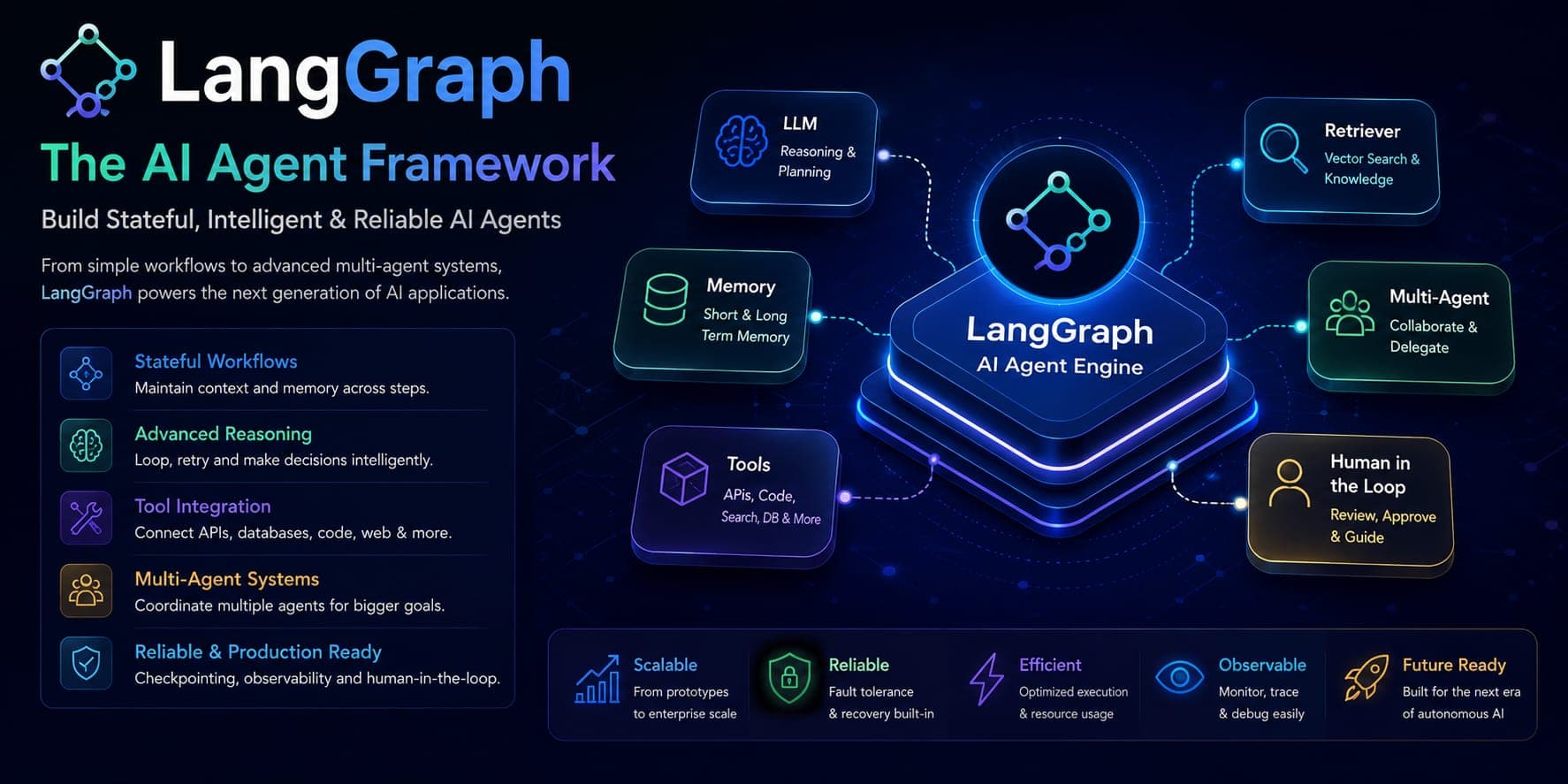
One of LangGraph's biggest advantages is its support for stateful execution. Most chatbot implementations process every request independently, with limited awareness of previous actions. LangGraph introduces a shared state that travels through the workflow. As the agent completes tasks, it updates this state with new information, tool outputs, retrieved documents, user preferences, intermediate reasoning, and execution history. Every node can access the latest state, allowing the workflow to make smarter decisions without repeatedly requesting the same information.
Reasoning is another area where LangGraph excels. Intelligent AI agents rarely solve difficult problems in a single attempt. They often need to evaluate different options, gather additional information, validate assumptions, or retry failed operations. LangGraph makes these iterative reasoning loops a natural part of the workflow. An agent can decide whether it has enough information, request additional context if necessary, verify the quality of its answer, and continue improving until the required objective has been achieved. This creates AI systems that behave more like problem solvers than text generators.
Tool integration is a core feature of the LangGraph ecosystem. Modern AI agents need access to browsers, APIs, databases, cloud services, file systems, search engines, calculators, and code execution environments. Rather than embedding every capability inside the language model, LangGraph allows developers to represent each external capability as a dedicated node within the graph. The agent determines when to use a tool, executes it, processes the result, and decides what action should happen next. This structured approach produces more reliable and transparent workflows while making debugging significantly easier.
LangGraph is also well suited for multi-agent systems. Instead of assigning every responsibility to a single AI model, developers can build specialized agents that collaborate on larger objectives. A research agent can gather information, a planning agent can organize the workflow, a coding agent can generate software, a testing agent can verify the implementation, and a reviewer agent can evaluate the final result. LangGraph coordinates communication between these specialized agents through shared state and clearly defined graph transitions. This architecture closely resembles how human teams divide responsibilities while working toward a common goal.
Another reason developers are adopting LangGraph is its support for human-in-the-loop workflows. Some decisions require human approval before execution, especially in industries such as healthcare, finance, cybersecurity, and legal technology. LangGraph allows workflows to pause, wait for human feedback, modify the execution state, and resume exactly where they stopped. This capability combines the efficiency of AI automation with the reliability of human oversight, making enterprise deployments safer and more practical.
Production reliability is equally important. Long-running AI workflows often encounter network failures, API rate limits, invalid tool responses, or unexpected user input. LangGraph provides checkpointing and durable execution mechanisms that help recover workflows without restarting the entire process. Instead of losing all progress after an interruption, the workflow resumes from the most recent successful checkpoint. This resilience is essential for enterprise AI applications that execute tasks over several minutes or even hours.
The LangGraph ecosystem continues to expand alongside advances in AI infrastructure. Developers frequently combine LangGraph with vector databases for semantic retrieval, memory systems for long-term personalization, observability platforms for monitoring, and Model Context Protocol (MCP) servers to connect AI agents with external tools and enterprise systems. This modular ecosystem enables developers to build sophisticated agent platforms without creating every component from scratch.
Real-world applications of LangGraph extend across many industries. Customer support platforms use it to retrieve documentation, analyze customer history, and generate accurate responses. Software engineering assistants plan development tasks, generate code, run automated tests, and verify deployment results. Research assistants collect information from multiple sources, compare findings, summarize evidence, and produce structured reports. Business automation systems integrate CRMs, email platforms, databases, calendars, and internal APIs into a single intelligent workflow capable of completing end-to-end business processes.
Although LangGraph offers significant flexibility, designing effective workflows still requires careful planning. Developers must determine how state should be managed, when the agent should call tools, how failures should be handled, and where human intervention is necessary. Well-designed graphs improve transparency, reduce hallucinations, simplify debugging, and create AI agents that are easier to maintain as projects scale.
As AI continues moving toward autonomous systems, frameworks like LangGraph are becoming foundational technologies rather than optional developer tools. The future of AI agents will depend not only on increasingly powerful language models but also on robust orchestration frameworks capable of managing reasoning, memory, planning, collaboration, and execution across complex environments. LangGraph represents this new generation of AI engineering by providing the structure needed to transform language models into reliable, intelligent, and production-ready AI agents capable of solving real-world problems at scale.