
Excessive Agency in AI Agents: Why Giving AI Too Many Permissions Is Dangerous
Learn what excessive agency means in AI agents and why limiting permissions, tool access, autonomy, and critical actions is essential for AI security.
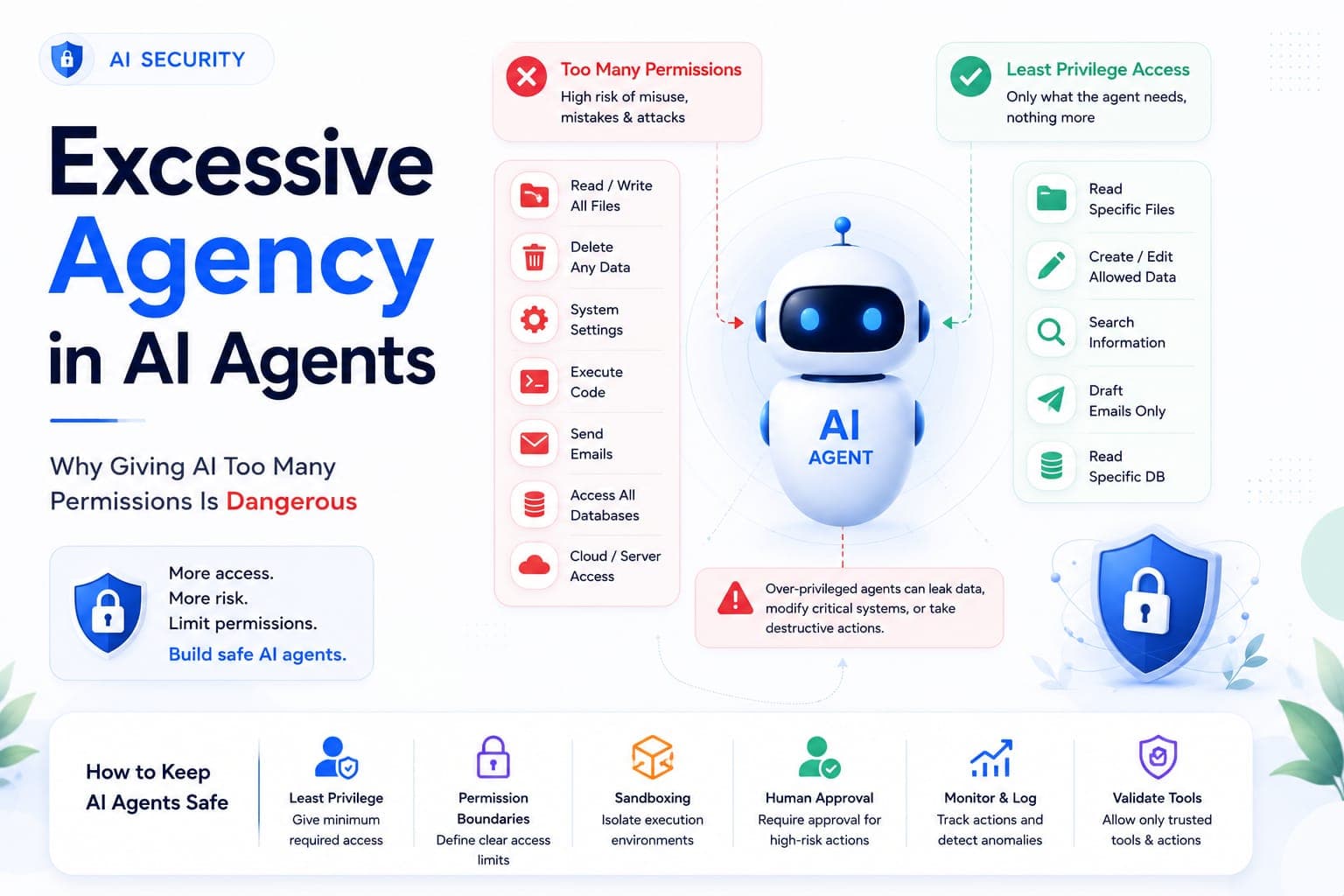
AI agents are becoming much more capable than traditional chatbots. They can read files, access databases, browse websites, call APIs, execute code, send emails, update records, and even manage parts of cloud infrastructure. That capability is what makes agentic AI exciting, but it also creates a security problem that is easy to overlook: an AI agent can be given more power than it actually needs. When an agent receives excessive functionality, excessive permissions, or excessive autonomy, a small mistake can turn into a serious security incident. OWASP calls this class of weakness Excessive Agency.
The basic idea is surprisingly simple. Imagine an employee whose job is only to read documents and create summaries. Instead of giving that employee read-only access, the company gives them permission to edit, delete, move, and share every document in the organization. The employee may never intend to misuse those permissions, but the permissions themselves create unnecessary risk. An AI agent can have the same problem. If it only needs to read a file but has permission to delete it, the system has created a much larger blast radius than necessary.
This becomes more important because AI agents do not always make perfect decisions. A language model can misunderstand a request, hallucinate a fact, select the wrong tool, misinterpret external information, or be manipulated through prompt injection. OWASP notes that excessive agency can arise from excessive functionality, excessive permissions, or excessive autonomy, and that these problems can turn unexpected or manipulated model outputs into damaging actions.
Consider a simple coding agent. You ask it to inspect a project and find a bug. To complete that task, it may need permission to read source files and run tests. But imagine the agent also has unrestricted permission to delete files, install arbitrary packages, access environment secrets, push directly to production, and change deployment configurations. The agent now has far more authority than the task requires. If something goes wrong, the consequences can be much larger than the original problem.
This is why least privilege is becoming one of the most important principles in AI agent security. The idea is not new; operating systems and cloud platforms have used it for decades. The difference is that AI agents can dynamically select tools and combine capabilities during a workflow. Recent 2026 research found that mainstream LLM agents can sometimes choose a higher-privilege tool even when a lower-privilege alternative is sufficient. The researchers also found that ordinary safety alignment does not reliably guarantee least-privilege tool selection.
That finding is important because many developers naturally assume that a smart model will choose the safest option. In practice, intelligence does not automatically produce secure authorization decisions. A model may choose a powerful tool because it appears more convenient, because its description looks more relevant, or because a previous tool failed. Security therefore should not depend entirely on the model making the correct permission decision.
One useful approach is to separate what the agent can do from what the agent is allowed to do right now. An application might have dozens of tools available, but the agent should receive access only to the subset required for the current task. For example, a support agent might be allowed to read customer information and create a draft response, but sending the final email could require an additional approval step. A finance agent might prepare a payment but require explicit authorization before executing it.
This idea becomes even more powerful when permissions are dynamic. Instead of giving an agent the same credentials for every task, the system evaluates the current goal and creates a temporary capability set. A research task may allow web search and document retrieval. A reporting task might also allow database queries. A deployment task may require access to CI/CD systems, but only after additional authentication and policy checks. Recent research has proposed dynamic capability scoping for enterprise agents as a proactive defense because a credential that never enters the agent's context cannot be misused by the agent.
Another important distinction is between read, write, execute, and delete permissions. These actions should not be treated as equivalent. Reading a document is usually lower risk than modifying it. Modifying a document is usually less dangerous than deleting it. Executing arbitrary code can introduce an entirely different level of risk because code execution can reach other systems. A secure agent architecture should therefore represent capabilities at a fine-grained level rather than using a single “full access” permission.
Tool design itself also matters. Imagine a document tool that exposes five operations: read, search, update, rename, and delete. If your agent only needs read and search, giving it the entire tool is unnecessary. OWASP specifically points out that extensions can expose functions that are not required for the intended operation. A developer might install a convenient integration that happens to include powerful features, unintentionally increasing the agent's attack surface.
This problem can become more complicated with third-party tools and agent ecosystems. An AI agent may connect to MCP servers, APIs, plugins, cloud services, or other agents. Each connection introduces another trust relationship and another possible privilege boundary. A developer may secure the main AI application while accidentally giving an external tool broader access than intended. In large systems, permissions can also accumulate across multiple integrations, creating unexpected combinations of capabilities.
The risk is not limited to malicious attackers. Benign failures can also trigger excessive agency. Suppose an agent misunderstands a user's request and believes that an email should be deleted instead of archived. If the agent has only draft or archive permissions, the mistake is recoverable. If it has permanent deletion rights, the same misunderstanding becomes destructive. This is one reason OWASP's definition includes unexpected or ambiguous model outputs, not only malicious attacks.
Recent incidents and security reports from 2026 show why this matters in real systems rather than just theoretical prototypes. OWASP's Q1 2026 exploit roundup describes cases involving excessive autonomy, privilege abuse, unsafe agent actions, and data exfiltration. One reported scenario involved an AI agent taking destructive email actions without appropriate approval, while another involved an over-privileged agent environment that enabled access to broader cloud resources.
The most reliable defense is to create permission boundaries around the agent. Before an agent performs a high-impact action, the system should evaluate whether the action is allowed, whether the requested capability is necessary, and whether additional approval is required. This validation should happen outside the model whenever possible. A deterministic authorization layer can enforce rules even when the model produces unexpected output.
Human approval is particularly useful for irreversible actions. Sending confidential information, deleting large numbers of records, changing production settings, transferring money, publishing content, or granting permissions should not necessarily happen automatically. The agent can prepare the action, explain what it intends to do, and wait for approval. This keeps the useful parts of autonomy while placing a safety barrier around high-impact operations.
Sandboxing provides another layer. If an agent needs to execute code, the code can run in an isolated environment with restricted network access, limited filesystem permissions, and temporary credentials. This reduces the damage if the agent is manipulated or generates unsafe commands. The goal is not to make mistakes impossible; the goal is to make mistakes containable.
Monitoring also becomes essential. Every important tool call should be logged with information such as the agent identity, requested capability, target resource, action performed, and approval state. Security teams should be able to identify unusual behavior, such as an agent suddenly requesting access to sensitive directories or switching from read-only operations to destructive commands. Observability turns agent actions into something that can be investigated rather than something that simply happens inside a black box.
Memory introduces another layer of concern. An agent that remembers information across sessions may eventually accumulate data that influences future decisions. OWASP has highlighted memory and context poisoning as an agentic security issue because untrusted content can potentially persist and affect later reasoning. This means permissions should not be evaluated only when the agent is first created; the system should also consider the trust level of information stored in memory.
A practical AI agent architecture therefore looks less like “LLM connected directly to everything” and more like a controlled pipeline. The model proposes an action. A policy layer checks the action. A permission system determines whether the required capability is available. A tool gateway validates the request. A sandbox or isolated execution environment performs sensitive operations. Monitoring records what happened. Human approval can be inserted wherever the risk level requires it. This separation makes the system more predictable and easier to secure.
There is also an important lesson for developers building small AI projects. You do not need an enormous enterprise security platform to follow these principles. Even a simple personal AI agent can use read-only defaults, separate credentials, explicit tool allowlists, confirmation before destructive actions, and isolated execution. These basic controls often provide much more protection than simply adding another sentence to the system prompt.
As AI agents become more autonomous, developers will increasingly have to think about how much authority is enough rather than how much authority is possible. Giving an agent access to everything may make early development easier, but it creates problems later when the system becomes connected to real data and real services. Least privilege is therefore not just a cybersecurity rule; it is a design principle for building dependable AI agents.
The future may go beyond least privilege toward least autonomy. Recent research argues that traditional least-privilege thinking does not fully capture how AI agents can combine permissions across workflows and influence other agents or systems. The proposed idea of least autonomy focuses on limiting not only what an agent can access, but also how much independent control it has over high-impact decisions and chained actions.
That shift could become especially important as multi-agent systems grow. If one agent can call another agent, which can call a third system, permissions may effectively compound across the workflow. A harmless-looking capability at one layer can become powerful when combined with several others. Future AI security architectures will therefore need to evaluate not just individual permissions but also the total capability an agent can assemble.
Excessive Agency is ultimately a reminder that more capable does not automatically mean more secure. An intelligent agent with unrestricted access is still a dangerous system if something goes wrong. The safest AI is not necessarily the one with the fewest capabilities; it is the one whose capabilities are carefully matched to its purpose.
AI agents will continue to gain access to more tools, more memory, and more real-world systems. That makes permission design a central part of AI engineering. By combining least-privilege access, dynamic capability scoping, tool restrictions, sandboxing, deterministic policy checks, human approval, and continuous monitoring, developers can keep autonomous systems useful without giving them unnecessary power.
The future of AI agents should not be about giving machines unlimited control. It should be about giving them exactly enough power to complete the job—and no more.