
Beyond Similarity: Why AI Memory Search Needs More Than Vector Similarity
Learn why AI memory needs more than vector similarity, using trust, context, provenance, and smart retrieval to build safer and more reliable AI agents.
AI Memory has become one of the most interesting areas of modern artificial intelligence. As AI agents move from short conversations toward long-term interaction, they need a way to remember useful information from previous sessions. The most common solution today is to store memories as embeddings and use vector search to retrieve information that is semantically similar to the user's current request. It is simple, powerful, and surprisingly effective. But there is a problem that becomes more serious as AI agents become more autonomous: the most similar memory is not always the right memory.
This distinction may look small, but it can completely change how a personal AI assistant behaves. Imagine asking an AI agent about a software project and receiving a memory that is semantically related to your question but actually belongs to a different project. The words may be similar, the embedding distance may be excellent, and the retrieval system may consider it a top result. Yet the memory is still wrong for the current situation. A useful AI Memory system therefore cannot stop at asking, “Which memory is most similar?” It also needs to ask, “Is this memory appropriate and safe to use here?”
This is the central idea behind a growing area of research often described as trustworthy memory search. A June 2026 study, titled Beyond Similarity: Trustworthy Memory Search for Personal AI Agents, argues that long-term memory should be treated as a security and trust boundary rather than simply a retrieval utility. The researchers found that semantically related memories could still cause problems such as cross-domain information leakage, sycophantic behavior, tool-call drift, and memory-induced jailbreaks.
The problem starts with the way vector search works. Suppose an AI memory database contains thousands or millions of memories. Each memory is converted into a vector representation, and a user query is also converted into a vector. The system calculates similarity and retrieves the closest candidates. This works extremely well when the only requirement is relevance. But AI agents often need more than relevance. They need context.
Consider a developer who works on two unrelated applications. Both applications may use the same programming language, database, and authentication framework. Now imagine the developer asks the AI to modify the authentication system in Project A. A vector search engine may retrieve a highly similar memory from Project B because both projects contain almost identical technical terminology. From a semantic perspective, the memory is relevant. From a project perspective, it is completely wrong. If the agent has tool access, this mistake could influence real actions.
This is why AI Memory is becoming more complicated than simply connecting an LLM to a vector database. The memory system needs to understand who, what, when, where, why, and under which circumstances a memory was created. A memory should have context, provenance, permissions, and possibly a confidence level. The embedding tells the system what a memory is about, but additional information needs to determine whether that memory should actually influence the current decision.
Temporal context is particularly important. A memory from two years ago may be semantically identical to a new memory but no longer be valid. Software versions change, user preferences change, projects evolve, and business policies are updated. A retrieval engine that only cares about similarity may continue returning outdated memories simply because they remain close to the current query in vector space.
This creates an important distinction between similarity and applicability. Similarity asks whether two pieces of information have similar meaning. Applicability asks whether one piece of information should influence the current task. These are not the same problem. Future AI Memory systems will increasingly need separate mechanisms for both.
Security makes this issue even more important. Imagine that a user has an AI agent connected to email, cloud storage, databases, and a collection of personal memories. If a malicious or incorrect memory is retrieved at the right moment, it may influence what the agent decides to do. The memory does not need to contain an obviously dangerous instruction. It only needs to affect the agent's reasoning in the wrong context. Once an AI agent has permission to take actions, memory retrieval becomes part of the control system.
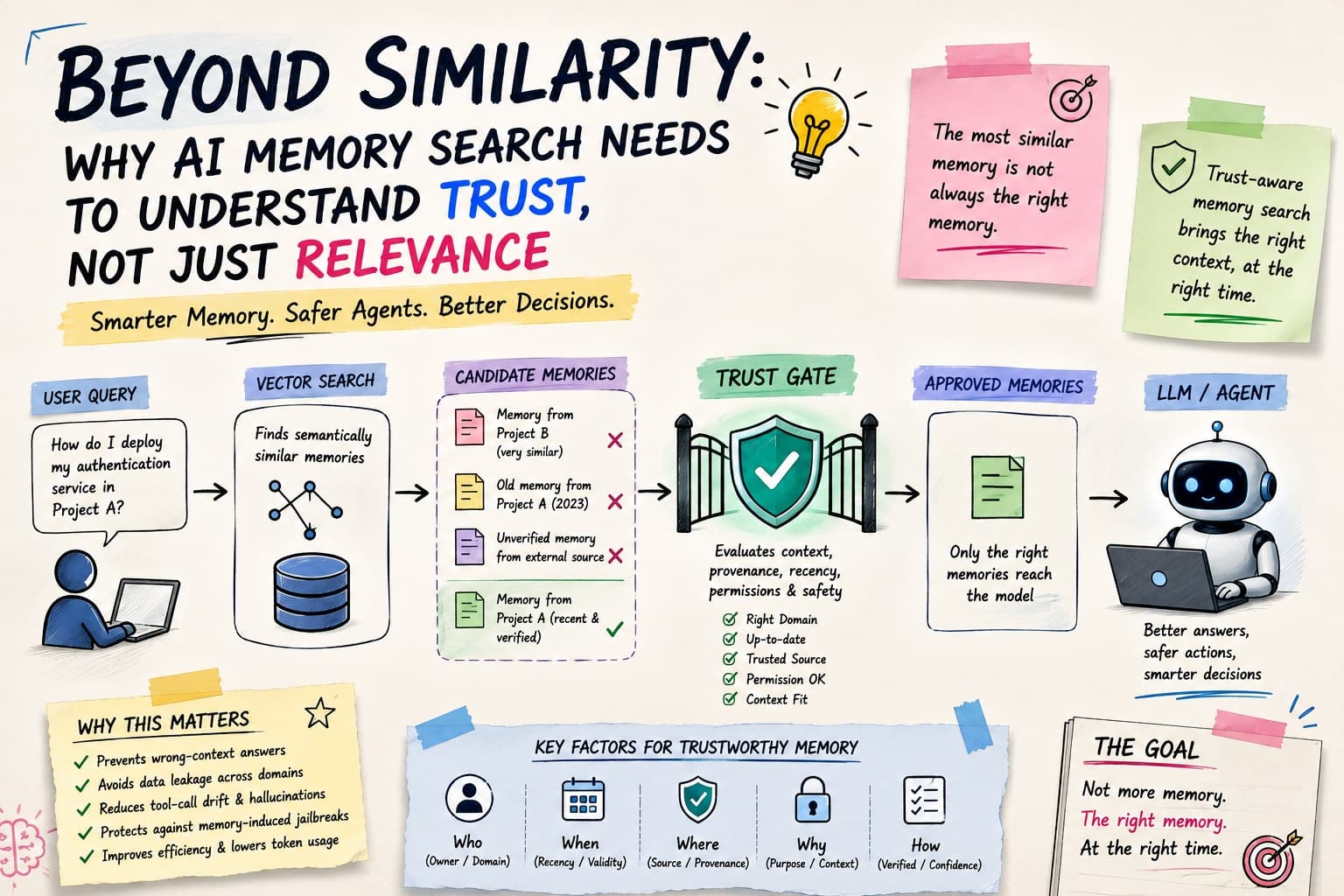
Researchers behind the 2026 MemGate work describe this as a memory trust boundary. They propose inserting a lightweight neural gate between the vector memory store and the language model. Rather than allowing every high-similarity memory to enter the model's context, the gate evaluates candidate memories in relation to the current query and determines which ones should actually be admitted. The reported system, MemGate, uses a 9-million-parameter model with a footprint of about 35.1 MB and does not require modifying the underlying LLM or rewriting the memory database.
The idea is interesting because it changes the architecture without requiring a completely new language model. Instead of replacing vector search, the system adds another intelligence layer on top of it. Vector search becomes the first filter that finds potentially relevant memories. A second layer then determines which of those memories are contextually appropriate enough to reach the model.
This architecture can be represented in a simple way:
User Query → Vector Search → Candidate Memories → Trust Gate → Approved Memories → LLM
The important step is the Trust Gate. It can evaluate factors that ordinary similarity search cannot fully capture. Is the memory from the correct project? Is it current? Was it explicitly confirmed? Is the source trustworthy? Does the memory conflict with newer information? Could using it expose data from another context? Does it contain an instruction that should not influence the agent?
This is a major shift in how developers may think about memory retrieval. The goal is no longer to retrieve the maximum amount of relevant information. The goal is to retrieve the minimum safe set of useful information.
This idea also connects naturally with context optimization. Large language models become expensive when unnecessary information is placed into the context window. If an AI agent retrieves twenty memories when only three are useful, it wastes tokens and increases the chance of irrelevant information influencing the response. Better memory filtering therefore provides two benefits at once: security and efficiency.
The same concept becomes valuable for long-running agents. A persistent agent may accumulate thousands of memories about a user's projects, preferences, documents, and previous actions. Over time, many of those memories will overlap. Some will become outdated. Others may only be relevant in very specific situations. Instead of continuously increasing the number of memories retrieved, an intelligent system can use relevance, trust, recency, and context to keep the active memory set small.
The research direction fits into a broader evolution in AI Memory. A recent ACL 2026 survey describes the development of agent memory as a movement from storage to reflection to experience. In the storage stage, the system mainly preserves trajectories. Reflection adds refinement and interpretation. The experience stage tries to transform previous interactions into reusable knowledge that can improve future decisions.
This evolution suggests that the memory layer itself is becoming intelligent. Instead of being a passive database, it may eventually act as a decision-making component that determines what information should be stored, how it should be represented, whether it should be trusted, and when it should influence the model.
Recent work on Agentic Memory shows another part of this transition. AgeMem integrates short-term and long-term memory management into the agent's policy and allows the agent to decide when information should be stored, retrieved, updated, summarized, or discarded. The research reports improvements in long-horizon task performance, memory quality, and context efficiency across several benchmarks.
Memory-R1 follows a related direction by learning memory operations such as ADD, UPDATE, DELETE, and NOOP using reinforcement learning. This is important because it suggests that memory decisions themselves can become learned behaviors instead of being controlled entirely by manually written rules.
Put these developments together and a very different picture of AI Memory begins to emerge. The future memory stack may contain several stages rather than one database. One component captures experience. Another extracts useful knowledge. A storage layer keeps long-term information. A retrieval engine searches for candidates. A trust layer determines which memories are appropriate. A context optimizer compresses the selected information. Finally, the language model uses the resulting memory to reason and act. This architecture could become particularly valuable for personal AI. Imagine an assistant that knows your work, projects, habits, preferences, and long-term goals. That assistant cannot simply treat every memory equally. A preference that applies to your personal writing may not apply to your business work. A decision from one project should not automatically influence another. A temporary instruction should not become a permanent rule. A private memory should not appear in a shared workspace.
This means future memory systems may need something similar to access control in traditional databases. Memories could belong to specific users, projects, domains, sessions, or security levels. Retrieval would then combine semantic similarity with permissions and context. A memory might be semantically perfect but still be denied because it belongs to another workspace.
Another important factor is provenance. A memory created directly by the user should usually carry a different trust level from one extracted automatically from an unknown webpage. Similarly, a fact confirmed repeatedly over time may deserve more confidence than a statement that appeared only once in an external document. Recording the origin of information gives the memory system another signal when deciding whether to use it.
This becomes critical when AI agents use external tools. A memory can influence which API the agent selects, what database it queries, which document it opens, or what action it decides to perform. In such systems, memory is no longer just part of the answer-generation process. It can indirectly control the agent's behavior. That is why memory retrieval increasingly needs to be considered alongside agent security, tool security, and permission management.
There is also a fascinating relationship between memory and hallucinations. Better retrieval does not automatically eliminate hallucinations. In some situations, a highly confident but incorrect memory can make an answer look even more convincing. The model receives a piece of retrieved information and may assume that it is trustworthy simply because it came from the memory system. A trust-aware memory architecture can reduce this problem by preserving uncertainty and provenance instead of presenting every retrieved memory as unquestionable truth.
The long-term direction is therefore not “more memory.” It is better memory selection.
An AI system with ten million memories does not necessarily have better memory than one with one hundred thousand well-organized memories. In fact, excessive memory can make an agent less reliable if retrieval becomes noisy, contradictory, or contextually confused. The goal should be to build a memory system that can maintain a large knowledge base while presenting the model with a small, high-quality working set.
This idea becomes even more important as AI agents operate for months or years. Long-lived agents will accumulate massive amounts of information. They cannot continuously inject everything they know into every interaction. Instead, they need a memory architecture that behaves more like an intelligent filter than a warehouse.
That is why the next phase of AI Memory research is so interesting. The challenge is moving from “Can the AI remember?” to “Can the AI decide what memory deserves to influence its current decision?”
The answer will likely involve multiple technologies working together: vector search for semantic retrieval, graphs for relationships, timestamps for temporal reasoning, provenance for trust, policy engines for permissions, compression for efficiency, and learned gating systems for contextual memory selection.
The result could be a new kind of AI memory that is not only persistent but also selective, context-aware, security-conscious, and adaptive. Instead of throwing more memories into a larger context window, the system continuously decides what matters now.
That may ultimately become one of the defining characteristics of truly intelligent AI agents. Human intelligence is not simply the ability to remember everything. It is the ability to remember the right information at the right moment.
AI Memory is beginning to move in that same direction.