
AI Prompt Engineering: How to Write Better Prompts for Better AI Results
Learn AI prompt engineering with practical techniques to write better prompts for text, coding, research, and professional AI image generation.
Artificial Intelligence can generate articles, write software, analyze documents, create images, summarize research, and help solve complex problems. Yet two people using the same AI model can receive completely different results. The difference is often not the model itself—it is the way the request is communicated. This is where AI Prompt Engineering becomes important. A prompt is more than a question typed into an AI chatbot. It is a set of instructions that gives the model enough context to understand what you want, how you want it, and what the final result should look like.
A simple prompt might say, “Create an image of a futuristic city.” The AI understands the basic idea, but almost everything else is left open to interpretation. Should the city appear realistic or illustrated? Is it daytime or nighttime? What should the architecture look like? Where is the camera positioned? What colors should dominate the scene? Is the image intended for a website banner, mobile wallpaper, advertisement, or social media post? Because these details are missing, the model has to make many decisions on its own. Sometimes the result looks great, but sometimes it looks completely different from what the user imagined.
A stronger prompt reduces this uncertainty. Instead of simply describing the subject, good prompt engineering communicates intent, context, constraints, visual direction, and output requirements. For example, a developer asking AI to create an authentication API could mention the programming language, framework, database, authentication method, expected endpoints, security requirements, and preferred response format. The AI now has a much clearer problem to solve. The same principle applies to writing, research, coding, data analysis, image generation, and AI agents.
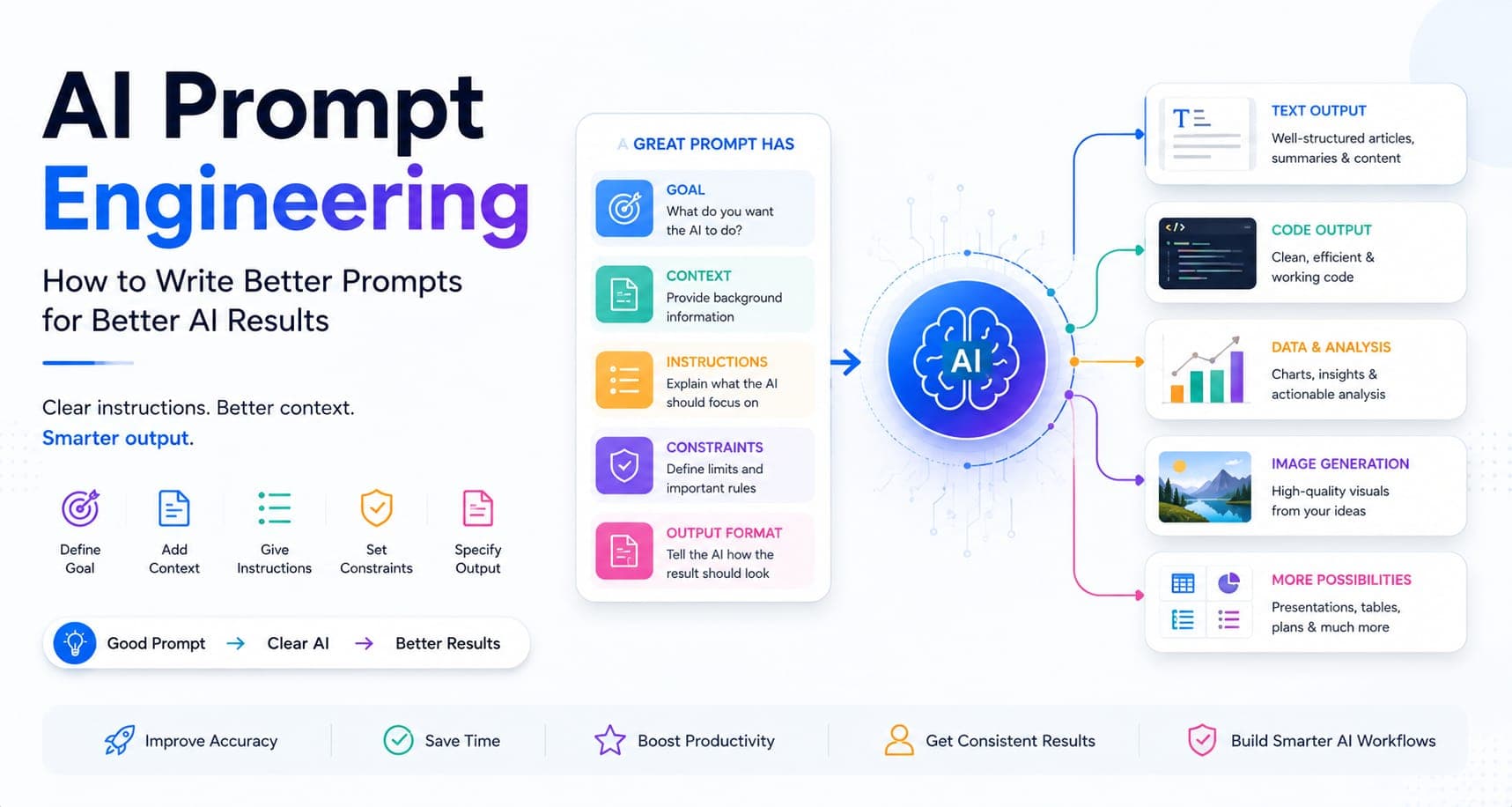
One useful way to think about prompting is through five building blocks: Goal, Context, Instructions, Constraints, and Output. The goal explains what needs to be achieved. Context gives the AI background information. Instructions describe how the task should be performed. Constraints define what should or should not happen. Finally, the output specification tells the AI exactly how the answer should be presented. Not every prompt requires all five elements, but difficult tasks usually improve when more of these elements are clearly defined.
Consider a writing example. A weak prompt might be, “Write about AI agents.” A better prompt would explain that the article is intended for software developers, should introduce AI agents in simple language, discuss reasoning, planning, memory and tool usage, use practical examples, avoid excessive technical jargon, and end by discussing future applications. The second prompt provides direction without attempting to write the article itself. This is an important distinction: effective prompting is not about making prompts unnecessarily long. It is about providing the information that actually changes the quality of the result.
Prompt engineering becomes especially important with image generation because visual output contains many variables. A useful image prompt should normally describe the main subject, environment, composition, camera perspective, lighting, visual style, important objects, color direction, aspect ratio, and unwanted elements. Instead of asking AI to “make it beautiful,” describe what beauty means for that particular image.
For example, imagine we want to create a hero banner for an article about AI Prompt Engineering. We want a professional technology visual rather than a generic robot image. The composition should communicate the idea that a human instruction enters an AI system and becomes multiple useful outputs.
A detailed image-generation prompt could look like this:
“Create a professional landscape technology blog banner about AI Prompt Engineering. Use a clean dark navy background with subtle blue and violet gradients. In the center, show a glowing AI processing core receiving a structured text prompt from the left. Visualize the prompt as clean floating instruction cards labeled Goal, Context, Instructions, Constraints, and Output. From the AI core, show several outputs flowing toward the right: a document, code window, analytical chart, and generated image preview. Use elegant connecting lines to communicate information flow. Keep the composition minimal, premium, and suitable for a modern AI engineering publication. Use cinematic but controlled lighting, sharp typography areas, subtle glassmorphism interface elements, and generous negative space. Landscape 16:9 composition. Avoid humanoid robots, cluttered backgrounds, excessive neon effects, distorted text, random icons, watermarks, and brand logos.”
Notice what this prompt does differently. “Professional landscape technology blog banner” establishes the purpose and format immediately. The dark navy, blue, and violet description defines the visual direction. The AI core becomes the primary subject, while the five instruction cards visually communicate the structure of a good prompt. The outputs on the right explain why prompting matters: one instruction can guide AI toward writing, coding, analysis, or visual creation.
The prompt also describes composition rather than only objects. This is extremely important in image generation. Saying “AI core, document, code, graph” gives the model a collection of objects. Saying that structured instructions enter from the left, pass through an AI core in the center, and produce outputs on the right gives those objects a relationship. The resulting image has a much better chance of communicating an actual idea.
Negative instructions can also improve results when used carefully. If a professional banner does not need robots, watermarks, crowded backgrounds, or random interface elements, explicitly mentioning those restrictions helps establish boundaries. However, negative prompting should not become an enormous list of everything imaginable that could go wrong. Focus on the mistakes most likely to damage the intended result.
Another useful technique is iterative prompting. The first result does not need to be perfect. Instead of rewriting the entire prompt every time, identify what is wrong and refine only that part. If the composition is good but the image is too colorful, request more restrained colors. If the visual hierarchy is weak, ask for a stronger central subject. If the banner looks crowded, request more negative space. Prompt engineering works best as a conversation between intention and output rather than a single attempt to predict every possible detail.
The same principle applies to Large Language Models. Start with a clear objective, evaluate the result, identify missing information, and improve the instructions. For complex tasks, prompts can even define a workflow: first analyze the problem, then gather relevant information, compare possible approaches, produce the final answer in a specified format, and finally verify that important requirements were satisfied. This structure becomes especially powerful when working with AI agents capable of using tools and completing multi-step tasks.
As AI models continue improving, some people assume prompt engineering will eventually disappear. The opposite is more likely. Models may become better at understanding vague requests, but communicating precise intent will remain valuable. The future of prompting may simply become more natural. Instead of memorizing unusual keywords or “secret prompts,” users will describe objectives, constraints, examples, preferences, and expected outcomes in increasingly structured ways.
Good prompt engineering is ultimately about reducing ambiguity. You do not need complicated vocabulary, enormous prompts, or hidden tricks. You need to understand what you are trying to achieve and communicate the details that matter. Whether you are generating code, creating a blog banner, designing an AI agent, analyzing business data, or producing an article, a well-structured prompt gives the AI a clearer path from your idea to the final result.
The most useful mindset is simple: do not ask only “What do I want the AI to create?” Ask “What information would the AI need to understand the result I have in mind?” Once that becomes part of your prompting process, AI becomes much less unpredictable and far more useful.