
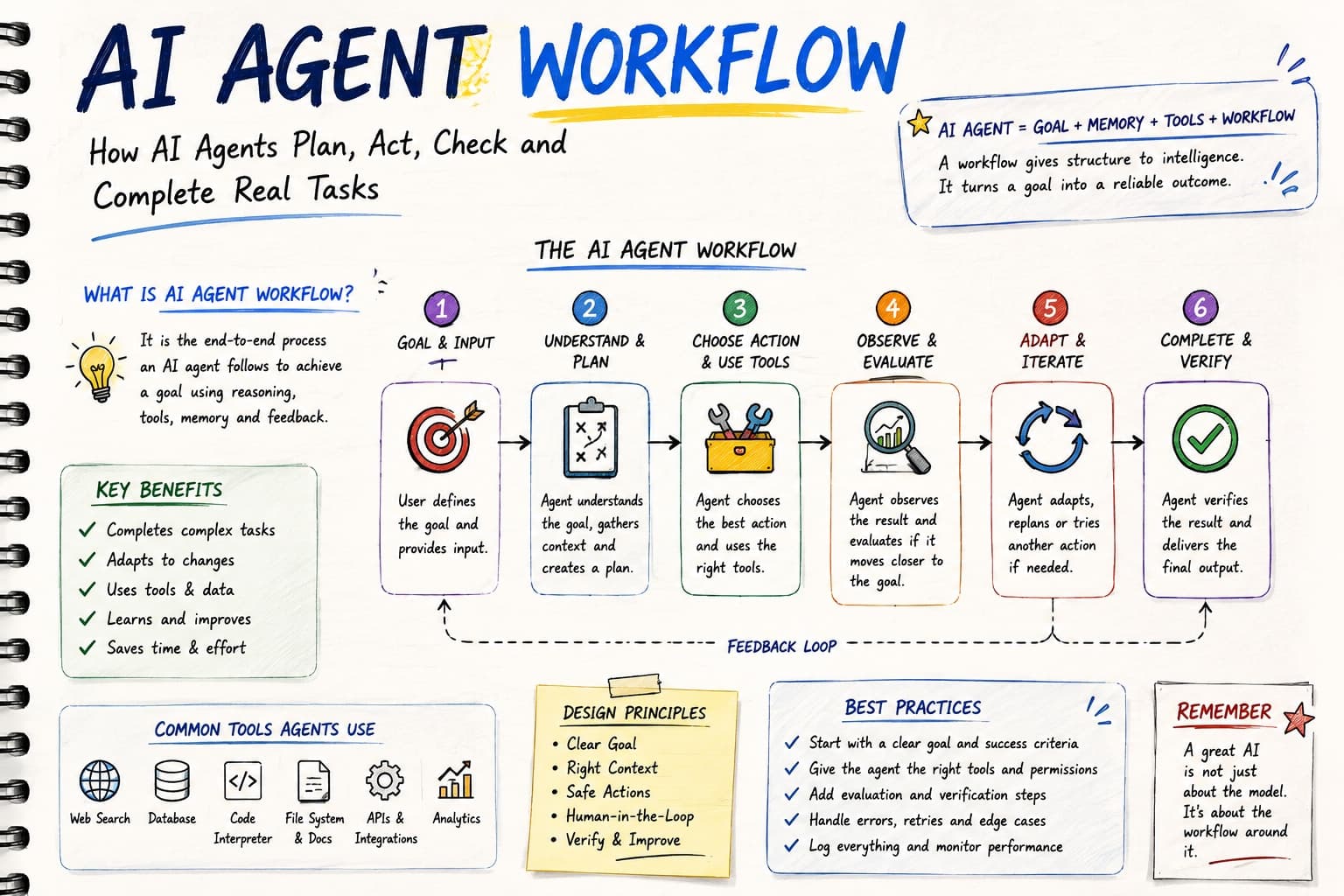
AI Agent Workflow: How Modern AI Agents Plan, Act, Check, and Complete Real Tasks
Learn how AI Agent Workflow enables agents to plan, use tools, verify results, handle failures, use memory, and complete complex tasks reliably.
The phrase AI Agent Workflow is becoming much more important as artificial intelligence moves beyond simple question-and-answer interactions. A few years ago, most AI applications followed a straightforward pattern: a user entered a prompt, a model generated a response, and the application displayed the result. That approach still works well for simple tasks, but it starts to break down when an AI system needs to research information, use several tools, make decisions, handle unexpected results, and complete a task from beginning to end. An AI agent workflow provides the structure that connects all of those actions into one working process.
At its simplest, an AI agent workflow is the process an AI agent follows to turn a goal into an outcome. The important part is that the process is not always completely fixed in advance. The agent can interpret the current situation, decide what should happen next, call an appropriate tool, inspect the result, and change direction when necessary. That ability to adapt is one of the main differences between an agentic workflow and traditional automation. Current developer guides describe this distinction in similar terms: traditional workflows largely define the steps beforehand, while agentic workflows allow the system to make runtime decisions within defined boundaries.
A useful way to understand an AI Agent Workflow is to imagine a software developer asking an AI to investigate a production bug. A basic chatbot might explain possible causes. An agent workflow can do much more. It can inspect logs, review recent code changes, search documentation, compare error patterns, reproduce the problem in a safe environment, suggest a fix, run tests, and prepare a summary for the developer. The value does not come from one amazing response. It comes from connecting many smaller actions into a coherent process.
The first part of a strong workflow is the goal. An agent needs to know what success actually means. “Work on this application” is too vague. “Identify the cause of the API timeout, propose a fix, test the fix without modifying production, and return the evidence” is much clearer. Defining the goal tightly also makes evaluation easier because the system can determine whether the task was completed instead of simply judging whether the generated text sounds good.
After the goal comes context. An agent rarely has enough information in the initial request to complete a complicated task. It may need files, previous conversations, database records, documentation, APIs, user preferences, or external research. Modern AI agent workflows therefore often connect the model to memory systems, retrieval systems, and business data. The workflow decides what context is relevant instead of dumping everything into the model. This is particularly important because giving an agent too much information can make the system slower, more expensive, and less focused.
The next stage is decision-making. The agent looks at the goal and available context and decides what action should happen next. This is where the workflow begins to feel different from traditional automation. A fixed workflow might always execute step A, then B, then C. An agentic workflow can decide that step B is unnecessary, that more information is required, or that a different tool should be used. That flexibility is useful when the environment is unpredictable, but it also creates a trade-off: the more freedom an agent receives, the harder it becomes to predict exactly what it will do. Current guidance on AI agent workflows increasingly emphasizes balancing autonomy with explicit constraints, monitoring, and evaluation.
Tool use is one of the most important parts of the AI Agent Workflow. A model can generate text, but real work often requires access to external systems. An agent might use web search for research, a database for structured information, a code interpreter for calculations, a filesystem for documents, an API for business data, or a deployment service for software delivery. Instead of simply telling the model that these capabilities exist, a well-designed workflow controls when those tools can be used and what permissions they have.
This creates a natural loop: reason, act, observe, and reason again. The agent selects a tool, receives the result, evaluates what happened, and decides whether to continue. This loop is one of the core ideas behind modern agentic workflows. It means the agent does not have to predict the entire execution path before starting. It can learn from intermediate results and adjust the next step accordingly. Practical guides published in 2026 describe these workflows as iterative systems in which agents interpret results and adapt instead of following a purely linear path.
However, an AI Agent Workflow should not simply continue forever. A reliable system needs a stopping condition. The workflow should know when the task is complete, when it has failed, or when it needs a human. This sounds obvious, but it becomes surprisingly important when agents are allowed to retry actions or make their own plans. Without clear termination rules, an agent can waste tokens, repeat failed actions, or enter loops that never produce a useful result.
Verification is therefore one of the most valuable stages in an AI workflow. Instead of trusting the first result produced by the model, the system checks whether the result satisfies the original goal. A coding agent can run tests. A research agent can compare sources. A data agent can validate calculations. A document-processing agent can check whether required fields were extracted correctly. This evaluator step turns a fragile generation pipeline into something much more reliable.
Different problems also require different workflow patterns. A sequential workflow is useful when each step depends directly on the previous one. A research task might collect information, analyze it, write a draft, and then review the draft. A parallel workflow can be faster when independent tasks can happen at the same time, such as asking multiple agents to research different sources. A router workflow can send different requests to specialized agents depending on the type of task. More advanced systems use an orchestrator and subagents, where a central agent divides a complex goal among specialized workers and combines their results. These patterns are now commonly discussed in AI agent workflow design because choosing the wrong structure can make an otherwise capable agent slow, expensive, or unreliable.
One of the most useful patterns is the evaluator-optimizer loop. In this design, one part of the system produces a result while another evaluates it against explicit criteria. If the result is weak, the workflow sends it back for improvement. This approach can be useful for code generation, document writing, research summaries, and other tasks where quality cannot be determined by a single model response. The important point is that the evaluation criteria should be defined clearly. “Make it better” is not a useful evaluation rule; “all API endpoints must pass the test suite and return the expected schema” is much more measurable.
Human involvement is also an important part of a modern AI Agent Workflow. The goal of agentic systems is not necessarily to remove people from every process. In many real applications, the better design is to automate low-risk steps and require approval for high-impact decisions. An agent can prepare a financial transaction without executing it, draft an email without sending it, or prepare a deployment without pushing to production. This creates a human-in-the-loop checkpoint where automation and accountability work together. Current production-oriented workflow guidance emphasizes this distinction because autonomy does not have to mean unsupervised execution.
Another part of workflow design that often gets ignored is failure handling. Real systems fail. APIs time out, databases return unexpected results, websites change formats, permissions expire, and models sometimes misunderstand the task. A production workflow needs retry rules, fallback tools, error states, and escalation paths. Instead of simply stopping when something goes wrong, the system should understand whether the error is temporary, whether another tool can solve it, or whether a person needs to take over.
This is where an AI Agent Workflow becomes closer to software engineering than prompt writing. The model may provide the intelligence, but the workflow provides the structure. Developers need to think about state, permissions, retries, observability, testing, data quality, security, and performance. Recent 2026 discussions around moving AI from prototypes into production repeatedly emphasize that the biggest challenges often appear at the workflow and integration layer rather than in the model alone.
Observability is another major requirement. When an agent performs ten actions before producing an answer, developers need to know what happened during those ten steps. Which tool was selected? What information was retrieved? Which decision caused the next action? Where did the workflow slow down? Why did the agent retry? Without this information, debugging an AI application can be extremely difficult. Modern agent platforms therefore increasingly treat traces, intermediate states, tool calls, and evaluation results as first-class data.
Security also needs to be designed into the workflow. An agent should not automatically receive unrestricted access to every tool simply because the application has those integrations. Permissions should match the task. Sensitive operations can require additional approval, and code execution can happen inside a sandbox. This becomes particularly important when workflows use external content because malicious instructions can enter through websites, documents, emails, or tool responses. A secure workflow creates boundaries between what the agent can read, what it can decide, and what it can actually execute.
Memory is another layer that can make an AI Agent Workflow much more powerful. Without memory, the agent treats every task as a new experience. With memory, it can remember successful approaches, project decisions, user preferences, previous failures, and useful context. But memory should not mean storing everything. The workflow needs to decide which information is worth keeping, how long it should remain relevant, and when outdated information should be updated or removed. This connects AI Agent Workflow directly to the growing field of autonomous AI memory.
A practical workflow might therefore look something like this: the user defines a goal, the agent retrieves relevant context, the planner creates a short plan, the agent chooses a tool, the tool produces a result, the agent evaluates that result, and then the workflow either continues, retries, asks for approval, or finishes. After completion, important information can be stored in memory for future tasks. The result is not simply a chain of prompts. It is a controlled system that moves between reasoning and action.
The biggest mistake developers can make is assuming that adding more autonomy automatically creates a better AI agent. It does not. More autonomy can also mean more failures, higher costs, harder debugging, and greater security risk. A good workflow gives the agent freedom where flexibility is useful and strict rules where mistakes are expensive. This balance between intelligence and control is what turns an impressive AI demo into a dependable application.
The future of AI Agent Workflow design is likely to become even more structured. Agents will work with long-term memory, external tools, specialized subagents, real-time data, human approval systems, and automated evaluators. Instead of building one giant agent that tries to do everything, developers will increasingly design systems where different components have clear responsibilities. The result will be AI applications that are easier to test, easier to monitor, and more capable of completing real-world tasks.
Ultimately, an AI Agent Workflow is the bridge between an intelligent model and useful software. A language model can generate ideas, but a workflow determines how those ideas become actions. It decides what the agent sees, what it does, what happens when it fails, when it should stop, and when a human should step in. That is why the future of AI agents will depend not only on better models, but on better workflows built around them.
The most useful question is therefore not, “Which AI model should I use?” It is, “What workflow will allow the AI to reliably achieve the goal?” Once that question becomes the starting point, AI agents become much easier to design, evaluate, secure, and scale.