
AI Agent Workflow: How Intelligent AI Agents Think, Plan, and Complete Tasks
Learn how AI Agent workflows combine reasoning, planning, memory, tool use, execution, and verification to automate complex tasks efficiently.
Artificial Intelligence is evolving beyond simple chatbots that answer questions. The next generation of AI is built around AI Agents—intelligent systems capable of understanding goals, making decisions, using tools, and completing complex tasks with minimal human intervention. While many people focus on the final output an AI agent produces, the real intelligence lies in its workflow. Every successful AI agent follows a structured sequence of reasoning, planning, execution, and learning. Understanding this workflow helps explain why modern AI agents are becoming more autonomous and significantly more capable than traditional AI assistants.
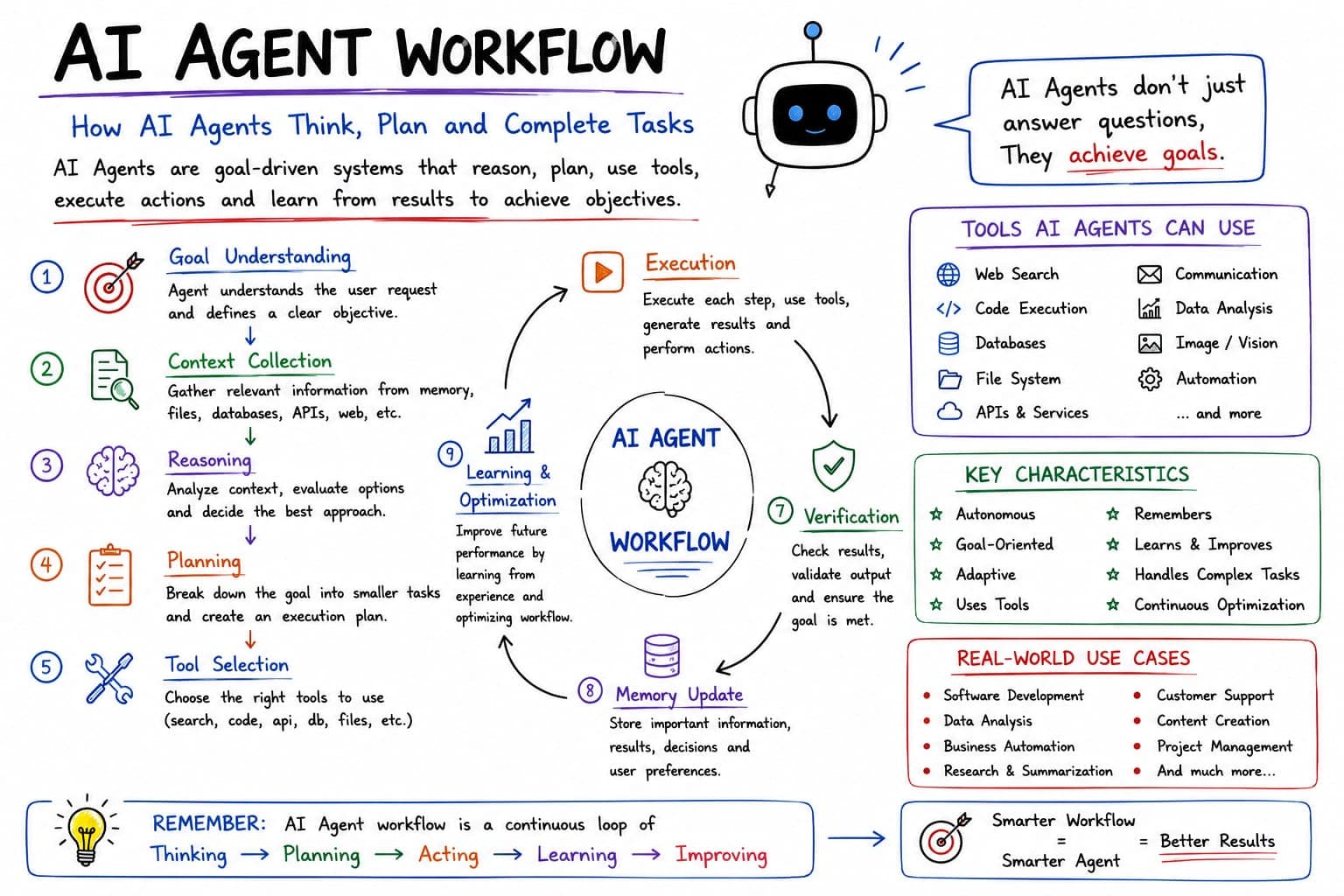
An AI Agent workflow begins with goal understanding. Unlike conventional AI that responds to individual prompts, an AI agent first identifies the overall objective. Instead of asking "What should I answer?", it asks "What needs to be accomplished?" This small difference completely changes how the system behaves. Whether the objective is writing software, analyzing documents, automating business operations, or planning a project, the agent first converts the user's request into a clearly defined goal.
Once the goal is understood, the next stage is context collection. Before taking any action, the AI gathers all relevant information required to make intelligent decisions. This may include previous conversations, user preferences, project documentation, company policies, APIs, databases, files, or external knowledge sources. Advanced AI agents don't simply rely on the language model's built-in knowledge. Instead, they retrieve fresh and relevant information using memory systems, semantic search, vector databases, or enterprise knowledge bases. Better context leads to better decisions.
After collecting context, the workflow moves into the reasoning phase. This is where the AI analyzes the available information and determines the best approach for solving the problem. Rather than immediately generating an answer, the agent evaluates possible strategies, identifies dependencies, predicts potential challenges, and chooses the most efficient execution path. Modern reasoning models spend more computation on difficult tasks, enabling AI agents to solve increasingly complex problems with greater accuracy.
The next step is planning. Large objectives are rarely completed in a single action. Instead, AI agents divide complex goals into smaller, manageable tasks. For example, if the objective is to develop a web application, the plan may include requirement analysis, UI design, backend development, database configuration, API integration, testing, deployment, and documentation. Each step depends on the successful completion of previous tasks, allowing the agent to execute work in a logical sequence rather than producing everything at once.
Planning is followed by tool selection. One of the defining characteristics of Agentic AI is its ability to interact with external tools instead of relying solely on language generation. Depending on the task, the agent may search the web, execute code, query databases, access cloud storage, communicate with APIs, edit documents, analyze images, or control other software systems. The language model becomes the decision-making engine, while external tools provide the ability to interact with the real world. This dramatically expands what AI systems can accomplish.
With the appropriate tools selected, the AI enters the execution phase. Here, the agent begins completing each planned task while continuously monitoring progress. Unlike traditional automation scripts that follow fixed rules, AI agents can adapt their behavior based on new information. If an API request fails, the agent may retry with different parameters. If generated code contains errors, it can debug and regenerate the implementation. If unexpected obstacles appear, the workflow adjusts dynamically without requiring the user to restart the entire process.
No intelligent workflow is complete without verification. After every major action, the AI evaluates whether the expected outcome has been achieved. It checks for logical errors, validates generated content, confirms API responses, verifies code execution, and measures whether the original objective has been satisfied. If the verification stage detects problems, the workflow returns to the reasoning or planning phase rather than delivering an incomplete result. This continuous feedback loop is one of the biggest differences between AI agents and traditional chatbots.
Memory plays an equally important role throughout the workflow. Every completed task generates valuable experience that can improve future performance. AI agents remember user preferences, successful strategies, project history, previous decisions, and recurring workflows. Instead of repeating identical reasoning for every request, they retrieve relevant memories and build upon earlier knowledge. Over time, this persistent memory transforms AI agents into increasingly personalized and efficient digital assistants capable of handling long-term projects.
The final stage of the workflow is learning and optimization. Although most production AI agents do not retrain their language models after every interaction, they continuously optimize their workflow by updating memories, improving plans, refining summaries, strengthening successful strategies, and discarding irrelevant information. This allows the agent to become faster and more effective without modifying the underlying model itself. Future AI systems are expected to perform even more sophisticated workflow optimization using adaptive planning, intelligent memory compression, and collaborative multi-agent coordination.
As AI technology continues to advance, workflows will become increasingly autonomous. Multiple specialized agents may work together, with one handling research, another creating plans, another writing code, another performing quality assurance, and another deploying the final solution. A coordinator agent manages communication between them, ensuring every component contributes toward the shared objective. This collaborative workflow mirrors how human teams operate and represents one of the most promising directions in artificial intelligence research.
Ultimately, an AI agent is far more than a chatbot with additional features. It is a complete decision-making system built around structured workflows that combine goal understanding, context retrieval, reasoning, planning, tool usage, execution, verification, memory, and continuous optimization. As these workflows become more intelligent, AI agents will evolve from digital assistants into autonomous collaborators capable of managing increasingly complex tasks across software engineering, healthcare, research, education, finance, manufacturing, and countless other industries. The future of artificial intelligence will be defined not only by smarter models, but by smarter workflows that enable AI to think, act, and improve with every task it performs.