
AI Agent Tools: How AI Agents Use APIs, Functions, MCP, and External Tools
AI Agent Tools let agents use APIs, databases, code, browsers, MCP, and external services to perform real-world tasks safely and efficiently.
An AI agent can be remarkably good at understanding language, but understanding a request is only half the problem. Real-world tasks usually require action. An agent may need to search the web, read a file, query a database, call an API, run code, create a calendar event, or update a business system. This is where AI Agent Tools become important. Tools give an AI agent the ability to move beyond generating text and interact with the systems around it.
A traditional chatbot mainly works inside a conversation. You ask a question, the model generates an answer, and the interaction ends there. An AI agent works differently. It may receive a goal, decide that it needs additional information, select a tool, execute that tool, inspect the result, and then continue working. In other words, the language model is not just producing an answer. It is deciding which capability should be used to make progress toward a goal.
One of the easiest ways to understand this is with a simple example. Imagine asking an AI agent, “Find the latest sales report, calculate the monthly growth, and send the summary to my team.” The model itself may know how to explain growth rates, but it cannot magically access your internal report or send an email unless the application provides those capabilities. The agent might use a file-search tool to locate the report, a data-analysis tool to calculate the numbers, and an email tool to prepare or send the final message. The intelligence comes from combining reasoning with tools.
This process is often called tool calling or function calling. The AI model decides that a particular external capability is needed and generates a structured request for it. The application then executes the function and sends the result back to the model. The model can use that new information to decide what should happen next. The important point is that the model is usually not directly performing the operation itself. It is selecting and describing the action, while the surrounding software actually executes it.
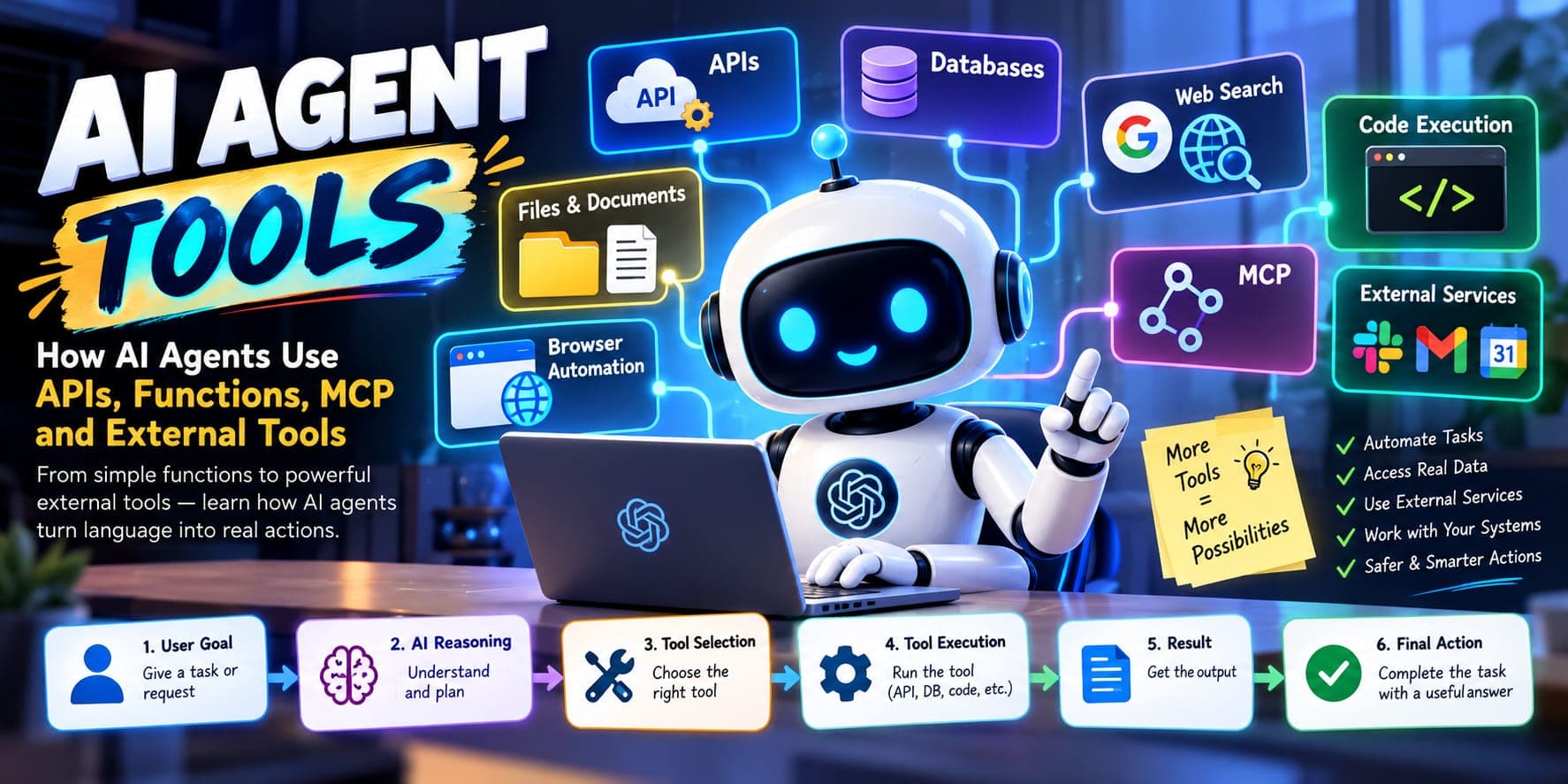
A simple workflow looks like this:
User Goal → AI Reasoning → Tool Selection → Tool Execution → Result → AI Reasoning → Final Action
This loop is the foundation of many modern AI agents.
For example, suppose a user asks, “What is the weather in Mumbai tomorrow?” The agent may decide that a weather service is required. It calls the weather tool, receives current forecast data, interprets the result, and produces a response. Now consider a harder task such as, “Compare three travel options, check prices, and recommend the best one.” The agent might use search tools, pricing APIs, location services, and a calculation function before producing the recommendation. A single prompt can therefore trigger multiple tools and multiple reasoning steps.
Not all AI Agent Tools are the same. Some are simple utility functions such as calculators, date conversion, or text processing. Others are powerful integrations such as databases, CRMs, payment systems, browsers, cloud infrastructure, or code execution environments. The more powerful the tool, the more carefully its permissions and inputs need to be controlled.
APIs are one of the most common tools available to AI agents. Almost every modern software platform exposes APIs for interacting with data and services. An AI agent can use these APIs to retrieve customer information, create tasks, search products, read analytics, update records, or trigger workflows. This makes APIs a natural bridge between language models and existing software systems.
Consider an AI sales agent connected to a CRM. A user might say, “Show me our most valuable leads that have not been contacted this week.” The agent could call a CRM search API, filter the results, compare deal values, and return a prioritized list. With another tool, it could create follow-up tasks for those leads. The agent is effectively acting as an intelligent interface over existing business infrastructure.
Databases are another major tool category. An agent may need to retrieve structured information that is not available in its model context. Instead of giving the model the entire database, the application can expose controlled database operations. The agent requests the information it needs, receives the result, and continues reasoning. This pattern is useful for dashboards, analytics assistants, inventory systems, customer support applications, and internal enterprise tools.
Code execution is especially powerful. Some tasks are difficult to solve reliably through text reasoning alone. Calculations, data transformations, simulations, log analysis, and file processing can often be handled better by executing code. An AI coding agent may generate a script, run it inside a controlled environment, inspect the result, fix errors, and execute it again. This creates a feedback loop where the model can learn from actual execution instead of guessing what the code would do.
Browsers are another important tool for agentic systems. A browser-enabled agent can navigate websites, search information, read pages, interact with forms, and perform other computer-use tasks. This is fundamentally different from traditional retrieval because the agent can operate within a changing environment. It has to understand what is currently visible, decide what action should happen next, and recover when a page behaves differently than expected.
This is one reason AI Agent Tools make workflows dynamic. A fixed automation might expect a button to always appear in the same place. An agent can potentially inspect the current interface and decide what to do when the environment changes. However, that flexibility also increases the need for clear boundaries, validation, and testing.
Another major development in the AI tool ecosystem is MCP, or Model Context Protocol. MCP provides a standardized way for AI applications to connect models with external tools, resources, and data sources. Instead of building a completely custom interface for every integration, developers can use a common protocol to expose capabilities to compatible AI systems. This has helped create a more organized ecosystem around tool-enabled agents.
The interesting part is that MCP is not simply about giving AI more tools. It also changes how developers think about the architecture around those tools. An agent may connect to a database server, documentation server, filesystem, or business application through standardized interfaces. As the number of available tools grows, the system needs better discovery, authorization, validation, and observability.
Tool selection itself is becoming a real engineering problem. Imagine an agent with 200 available tools. Showing every tool in detail all the time can increase context size and make selection more difficult. A better system may use tool discovery, retrieval, namespaces, metadata, or routing so that only relevant capabilities are exposed at the appropriate moment. This is an important direction for scalable agent architecture.
Tool descriptions also matter more than many developers realize. The model often relies on the tool name, description, schema, and examples to understand when it should be used. Poorly designed descriptions can lead to incorrect tool selection. Overly broad descriptions can cause ambiguity. Conflicting descriptions can make the agent choose the wrong capability. Clear tool contracts therefore improve not only usability but also reliability.
At the same time, tools create a new security boundary. An AI model may produce an incorrect action, but the application should not blindly execute everything the model requests. A tool gateway can validate arguments, check permissions, enforce policies, and reject operations that are outside the agent's allowed scope.
This becomes especially important for high-impact tools. Reading a document is relatively low risk. Deleting a document is much more serious. Creating an email draft is different from sending the email. Querying a database is different from modifying production data. A secure agent architecture should therefore treat tool operations according to their risk level.
This is where least privilege becomes essential. An agent should receive only the permissions needed for its current job. A research agent might need search and document access but no email permissions. A coding agent might need repository access but not financial APIs. A customer-support agent might read customer records but not delete them. Restricting capabilities reduces the impact of mistakes, prompt injection, tool poisoning, and other failures.
Another important concept is tool validation. Before a tool action reaches the external system, developers can inspect the requested operation. For example, a database tool might allow only read queries by default. A deployment tool might require approval before production changes. An email tool might prevent sending to unknown recipients. These checks happen outside the model, which means they do not depend on the model always making the correct decision.
Tool execution also benefits from sandboxing. Code, shell commands, browser automation, and other risky operations can run inside isolated environments. The agent may still be able to perform useful work, but the execution environment limits what can be accessed. This is particularly valuable when agents process untrusted data or generate code dynamically.
Observability is another important part of the AI Agent Tool architecture. Developers need to know not only what answer the model produced but what tools it used to reach that answer. A production system may record the agent's tool calls, parameters, execution time, errors, retries, and results. These traces make it much easier to identify unexpected behavior, optimize performance, and investigate security incidents.
There is also a deeper architectural idea behind all of this: tools transform AI from a language system into an action system. A language model can describe how to book a meeting, update a CRM, or deploy an application. A tool-enabled agent can potentially do those things. That difference is enormous because the system is no longer judged only by the quality of its generated text. It must also be judged by whether its actions are correct, authorized, reversible, and safe.
This creates a new way of evaluating AI systems. A chatbot might be evaluated using answer quality, factuality, and helpfulness. An AI agent also needs to be evaluated based on tool-selection accuracy, execution success, recovery from failures, permission compliance, and the quality of its decisions across multiple steps.
The best agent architecture therefore does not simply connect an LLM to as many tools as possible. It creates a controlled environment where tools are discoverable, understandable, permissioned, validated, observable, and easy to replace. The goal is to give the agent enough capabilities to complete useful work without turning every integration into a potential source of failure.
Looking ahead, AI Agent Tools are likely to become even more modular. Agents may discover capabilities dynamically, use specialized tools only when necessary, delegate work to other agents, and operate through standardized protocols such as MCP. Tool ecosystems may become as important to agent development as application libraries are to traditional software engineering.
This could eventually lead to something like an AI operating layer for software, where models are responsible for reasoning while tools provide the capabilities that let them interact with the environment. One agent might research using web tools, analyze data using code execution, update a database, communicate through an email service, and request human approval before taking a sensitive action. The system becomes a coordinated network of intelligence and capabilities.
But the most important principle remains simple: giving an AI more tools does not automatically make it a better agent. The quality of an AI agent depends on whether it knows which tool to use, when to use it, how to use it, and when not to use it. AI Agent Tools are ultimately the bridge between reasoning and action. They allow an AI system to move from “I know how this could be done” to “I can safely help get it done.” As AI agents become more capable, that bridge will become one of the most important parts of the entire architecture