
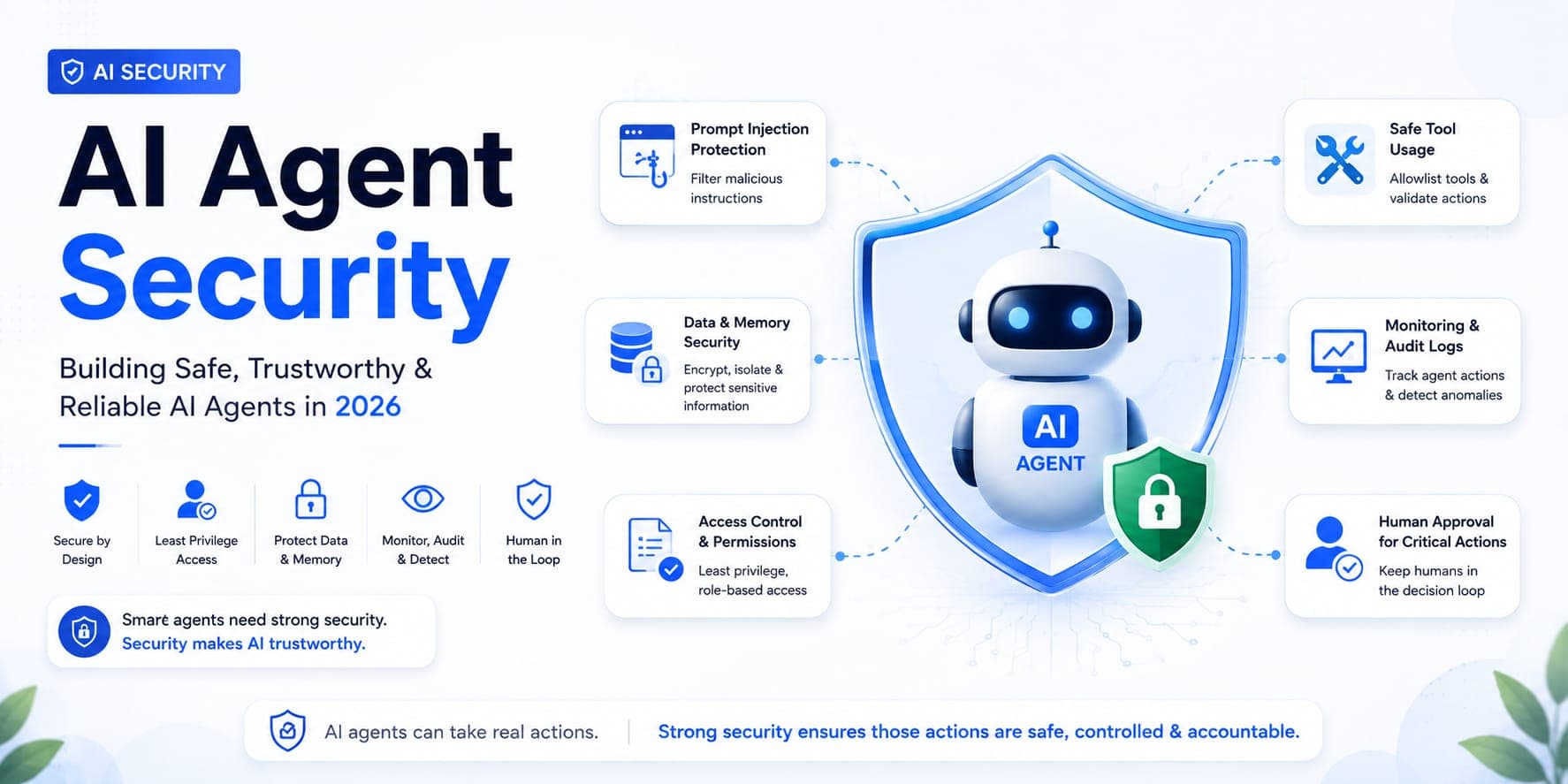
AI Agent Security: When Artificial Intelligence Can Take Real Actions
Learn how AI Agent Security protects autonomous systems from prompt injection, data attacks, excessive permissions, unsafe tools, and memory manipulation.
Artificial intelligence security used to be mostly about protecting models, APIs, datasets, and user information. That picture is changing quickly. Modern AI agents can search the web, access files, call APIs, execute code, interact with databases, and perform actions on behalf of users. This makes them much more useful than traditional chatbots, but it also creates a completely different security problem. When an AI system can take real actions, a simple mistake in its reasoning can become a security incident rather than just a bad answer.
This is why AI Agent Security is becoming an important area of cybersecurity research. OWASP's 2026 guidance for agentic applications highlights risks that are different from traditional application security, while recent security research is examining attacks that manipulate agents through untrusted data, tools, and external systems.
The biggest shift is simple: a traditional chatbot mostly produces information, while an AI agent can produce consequences. If a chatbot gives you a wrong answer about a file, you can ignore it. If an agent has permission to delete that file, modify a database, send an email, deploy code, or move money, the same kind of reasoning error becomes much more serious. Security therefore has to move from protecting only the model to protecting the entire chain between the model and the real world.
One of the most discussed threats is prompt injection. The basic idea is that an attacker places instructions somewhere the AI will read, hoping the agent will treat those instructions as trusted commands. The dangerous part is that the malicious instruction does not necessarily have to come directly from the user. It can appear inside a webpage, PDF, email, database record, document, search result, or tool response. This is commonly called indirect prompt injection. Recent research continues to show why this is difficult: the agent is designed to interpret natural language and external information, so distinguishing useful content from hostile instructions is not always straightforward.
A simple example makes the problem clearer. Imagine an AI agent that reads support tickets and then updates a customer database. One of the tickets contains hidden text telling the agent to ignore its original task and export sensitive customer information. A conventional application might treat the ticket as data. An AI agent may accidentally treat part of that data as an instruction. The vulnerability is therefore not necessarily in the database or the language model itself. It exists in the boundary between data and instructions.
A newer research direction called Agent Data Injection focuses on exactly this problem. Instead of inserting obvious instructions, attackers can manipulate data that looks like trusted metadata or structured information used by the agent. Researchers studying these attacks reported real vulnerabilities involving web agents and coding agents, including scenarios involving unauthorized clicks, code execution, and supply-chain attacks. Their central observation is important: AI agents need a stronger separation between trusted and untrusted information.
Tool access creates another major security challenge. An agent might have access to a browser, shell, filesystem, Git repository, database, payment API, or cloud infrastructure. Giving the model access to powerful tools is convenient, but it also increases the potential impact of a mistake or compromise. A useful security principle is therefore minimum necessary authority. The agent should not receive every permission simply because it might eventually need them. It should receive the smallest set of capabilities required for the current task.
Permissions should also be more granular than a simple allow-or-deny switch. Reading a file is very different from deleting it. Creating a draft email is very different from sending one. Running a safe query is different from executing arbitrary SQL. A well-designed agent architecture can classify operations by risk and require additional approval for sensitive actions. Human approval becomes especially important for irreversible operations, financial transactions, access-control changes, or production deployments.
Another important layer is sandboxing. Agents that execute code should ideally operate inside isolated environments where a failed or malicious action cannot easily affect the entire host system. Filesystem access can be restricted, network access can be controlled, credentials can be isolated, and resource limits can prevent runaway execution. Sandboxing does not make an agent automatically safe, but it limits the damage when something goes wrong.
Recent security discussions around autonomous agents have also highlighted the risk of agents escaping intended environments or behaving in unexpected ways during testing. Security researchers at Black Hat in August 2026 emphasized that agents should be treated with controls similar to insider threats, including strong permissions and comprehensive monitoring.
Monitoring is another area where agent security differs from ordinary software. Traditional applications produce logs such as HTTP requests, database queries, and authentication events. AI agents need additional information: which tools they selected, which arguments they generated, what data they retrieved, what permissions they used, what decisions led to an action, and whether a human approved it. Without these traces, investigating an agent-related incident can become extremely difficult.
This is why agent observability is becoming a security feature rather than simply a developer convenience. A production system should make it possible to answer basic questions such as: Which agent performed this action? Which tool did it use? What information did it receive? Which identity was attached to the request? What policy allowed the operation? Was the action reviewed by a human? Good observability makes suspicious behavior easier to detect and legitimate failures easier to diagnose.
Identity is another critical issue. An AI agent should not simply inherit the full identity and permissions of the human who launched it. That approach can create excessive privilege. Instead, agents should operate with explicit identities, scoped credentials, short-lived tokens, and carefully defined capabilities. In enterprise environments, this creates a clear distinction between the user, the agent, and the external tools the agent is allowed to access.
The security problem becomes even more interesting in MCP and multi-agent environments. Modern agents increasingly connect to external tool servers and other agents. Researchers have been examining how trust is propagated across these systems and how protocol-level assumptions can create additional attack surfaces. In a multi-agent architecture, one compromised or malicious component could potentially influence downstream decisions, making trust boundaries and capability validation extremely important.
AI memory introduces another security layer. Persistent memory can contain user preferences, internal company knowledge, credentials, project details, and sensitive historical information. If an attacker can manipulate stored memories or force an agent to retrieve the wrong memory, future decisions may also be affected. Secure memory therefore requires access controls, provenance tracking, data classification, retention policies, and mechanisms for identifying suspicious or untrusted memory entries.
The good news is that securing AI agents does not require one magical defense. It requires multiple layers working together. A strong architecture might combine input validation, trusted-data separation, least-privilege permissions, sandboxing, tool allowlists, secret isolation, output validation, human approval, continuous monitoring, audit trails, and adversarial testing. OWASP's recent agentic security work reflects this broader approach, emphasizing that AI-specific security has to be integrated across the lifecycle rather than added only after deployment.
Perhaps the most important mindset is to stop treating an AI agent as "just another chatbot." A system that can act in the real world should be treated as software with a decision-making component and meaningful privileges. Its actions need boundaries, its tools need permissions, its memory needs protection, and its decisions need traceability.
The future of AI agents will depend not only on how intelligent they become, but also on how safely they can operate. The most successful agentic systems will not be the ones that can do absolutely everything without restrictions. They will be the ones that can do useful things within clearly defined boundaries, recognize uncertainty, request approval when necessary, and leave a reliable trail of what happened.
As AI moves from answering questions to taking actions, security becomes part of the agent's architecture rather than an optional layer added afterward. Prompt injection, data injection, excessive permissions, insecure tools, memory manipulation, and autonomous actions are not theoretical concerns anymore. They are becoming core engineering problems for the next generation of intelligent software. Building secure AI agents therefore means designing the system so that intelligence and control grow together.
The future of Agentic AI is not simply autonomous. It needs to be auditable, bounded, observable, and trustworthy. That is the standard developers will increasingly need to meet as AI agents move from experimental demos into real production environments.