
AI Agent Memory: How AI Learns What to Remember, Update & Forget
Discover how AI Agent Memory works in 2026, helping AI systems decide what to remember, update, retrieve, and forget for smarter autonomous agents.
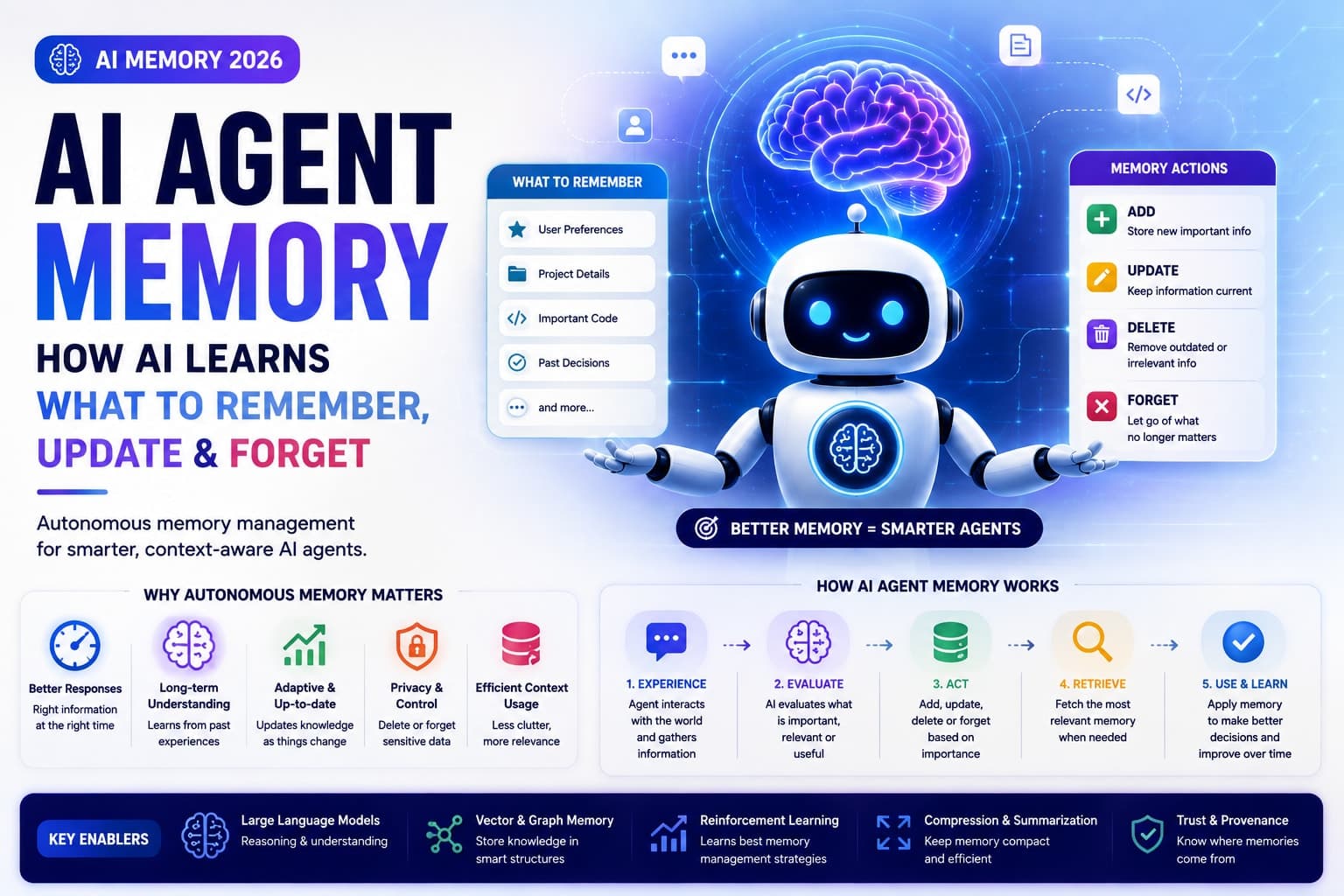
For a long time, AI memory was treated as a storage problem. Developers created a database, stored conversations or extracted facts, generated embeddings, and retrieved similar information whenever a user asked a question. It worked, but there was always a weakness hiding underneath the system: the AI itself was rarely deciding what was worth remembering. The memory pipeline was usually controlled by fixed rules written by developers. In 2026, that idea is beginning to change. New research is exploring a more interesting direction where AI agents can actively manage their own memory—deciding what to store, what to retrieve, what to update, what to summarize, and even what should be forgotten.
This shift may sound like a small engineering improvement, but it could become one of the most important changes in AI agent architecture. An AI that can reason about its own memory is fundamentally different from an AI that simply has access to a database. The database provides storage. The agent provides judgment. The combination creates a system that can continuously organize its knowledge while working through long-running tasks.
A recent ACL 2026 paper introduced Agentic Memory, or AgeMem, a framework that brings long-term and short-term memory management directly into the agent's policy. Instead of treating memory as a separate external utility controlled entirely by heuristics, the agent can perform memory operations as actions. It can decide when to store information, retrieve previous knowledge, update an existing memory, summarize it, or discard it. The researchers trained these behaviors with reinforcement learning and reported improvements across several long-horizon benchmarks, including better task performance, higher-quality memories, and more efficient use of context.
This is an important idea because real human memory does not work like a simple database. We do not permanently save every sentence we hear. We remember some experiences strongly, forget others, combine repeated experiences into general knowledge, and retrieve information differently depending on what we are currently doing. Agentic Memory research is moving toward a similar philosophy: memory should not just exist; it should be managed intelligently.
Consider a software developer working with an AI agent for several months. During that time, the developer may discuss hundreds of APIs, bugs, deployment decisions, design preferences, experiments, and implementation details. A naive memory system could store thousands of separate records. Eventually, the agent has a huge memory bank full of duplicates, outdated information, and irrelevant details. Retrieval becomes harder because the system has too many similar memories competing for attention.
This is where autonomous memory management becomes valuable. Instead of keeping everything forever, the agent could recognize that ten different conversations all express the same preference and merge them into one stronger memory. It could notice that an old API has been replaced and update the relevant knowledge. It could decide that a temporary debugging detail is no longer useful and remove it. It could also recognize that a particular project decision is important enough to keep permanently.
Another research direction is Memory-R1, presented at ACL 2026. The system separates memory management from answering by using a Memory Manager and an Answer Agent. The Memory Manager learns operations such as ADD, UPDATE, DELETE, and NOOP, while the Answer Agent identifies and reasons over relevant memories. The researchers reported that the system could learn these behaviors through reinforcement learning and generalize across multiple benchmarks and model sizes.
The importance of the ADD, UPDATE, DELETE, and NOOP operations should not be underestimated. In many existing memory systems, storage is the easy part. Developers can always write another record to a database. The hard part is deciding whether a new piece of information deserves to be added at all. Sometimes the correct answer is actually NOOP—do nothing. This prevents memory systems from becoming cluttered every time the user says something that sounds interesting but has no long-term value.
The UPDATE operation is equally important. Human knowledge changes. Users change jobs, move to new projects, switch technologies, adopt new preferences, and correct previous assumptions. If an AI only adds memories without updating older ones, contradictory information gradually accumulates. A genuinely useful memory system needs to understand that a new fact may replace or modify an existing one.
DELETE is perhaps even more important from both an efficiency and privacy perspective. Not every memory should live forever. Some information becomes irrelevant. Some information may be incorrect. Some information may be sensitive and should be removed. A memory architecture that treats deletion as a first-class operation can maintain a cleaner knowledge base and provide stronger user control.
At the same time, researchers are exploring a different problem: how to make memory itself more lightweight. ACL 2026 also introduced LightMem, a memory system that uses Small Language Models to help with retrieval, writing, and long-term consolidation. The architecture separates online memory operations from offline consolidation so that expensive processing does not have to happen every time the user interacts with the system. The goal is to improve memory quality without continuously paying the latency cost of large-model memory operations.
This separation between online and offline processing could become extremely important for production AI systems. Imagine an assistant that interacts with a user hundreds of times per day. It would be expensive to run a large language model after every message simply to reorganize memory. Instead, a lightweight model could handle quick decisions during the interaction while a deeper consolidation process runs later, merging memories and cleaning the knowledge store when computational resources are available.
Another major research direction is memory compression. Long-running agents can accumulate enormous histories, and simply storing everything in raw text becomes expensive. A 2026 study on structured distillation for personalized agent memory reported an approach that reduced the average representation of conversation exchanges by roughly 11 times while preserving much of the retrieval performance in its experiments. The key idea was to transform long conversation history into compact structured memory rather than keeping every exchange in its original form.
This is more than a storage optimization. Compression directly affects the amount of context that needs to be provided to the language model. A smaller, better-organized memory means fewer tokens, faster retrieval, lower inference costs, and less irrelevant information entering the model's working context. In other words, memory optimization and inference optimization are becoming increasingly connected.
Other work is taking compression even further by changing how long-context reasoning operates. A 2026 ACL paper on LycheeMemory proposes compressing chunks of long input into memory representations and using a learned gating mechanism to select which memory blocks are actually relevant to the reasoning process. Rather than forcing the model to process every raw token, the system selectively recalls compressed information.
That idea points toward an important future architecture: AI systems may no longer need to choose between “small context” and “huge context.” Instead, they may maintain a large external memory while presenting the language model with only a carefully selected working set. The memory system becomes responsible for filtering and organizing information, while the model focuses its expensive reasoning on the pieces that matter.
There is also growing interest in structured memory, where AI knowledge is represented using multiple relationships instead of a single vector store. The MAGMA architecture proposed in ACL 2026 represents memories across semantic, temporal, causal, and entity graphs. Rather than retrieving information purely through similarity, the system can navigate different relationships depending on the question.
This could solve one of the biggest weaknesses of simple vector-based memory. Two pieces of text may have similar meanings while having very different roles in a user's history. A memory system may need to know not only that two events are semantically related, but also which happened first, what caused what, who was involved, and whether one event changed a previous decision. Temporal and causal relationships become especially important for long-running agents.
Another interesting approach comes from Hindsight, a structured agent-memory system presented at ACL 2026. It separates memory into logical networks for the world, experience, observation, and opinion, making a distinction between what the agent treats as objective knowledge and what it believes or thinks based on previous experience. Its design combines vector search, keyword matching, graph traversal, and temporal filtering.
The idea of separating facts from beliefs could become extremely useful. AI systems often mix information they know with information they inferred. If an agent remembers both in exactly the same form, a future retrieval can make an uncertain assumption look like a confirmed fact. A memory architecture that preserves this distinction gives the agent more information about how much confidence it should place in a retrieved memory.
This brings us to perhaps the most important change happening in AI Memory: memory is moving from passive storage to active reasoning infrastructure. Traditional architecture looks something like this: the user sends a message, the system creates an embedding, searches a vector database, retrieves several records, and places them into the prompt. The memory system is mostly invisible and rule-driven. The new architecture is more dynamic. The agent can decide that it needs memory, choose what kind of memory is relevant, retrieve specific information, compare it with current context, update old memories, and decide whether the new experience should be retained.
That makes memory part of the agent's decision-making process rather than simply an accessory.It also creates new security challenges. Once an AI can autonomously write, modify, or delete its memory, developers need to think carefully about provenance and trust. A malicious document, webpage, or tool could attempt to insert misleading information into persistent memory. The agent could then retrieve that information days later and treat it as trusted knowledge. This is why the growing research around AI Memory must be considered alongside memory poisoning, permission control, and secure retrieval.There is another practical problem: autonomous memory can become too aggressive. An agent that remembers everything may be inefficient. An agent that forgets too much may become unreliable. The real goal is therefore not maximum memory—it is useful memory.
Useful memory has to balance several competing factors. It should be relevant enough to help future tasks, stable enough to remain useful, trustworthy enough to influence decisions, compact enough to be affordable, and flexible enough to change when reality changes. This is a much more difficult problem than simply storing embeddings.
The future of AI Memory may therefore look increasingly similar to a small operating system for knowledge. There could be memory policies, priorities, permissions, expiration rules, confidence scores, source tracking, compression processes, background consolidation, and specialized retrieval strategies. The language model will not necessarily manage all of this directly. Instead, memory could become an intelligent subsystem working alongside the model.
For developers, this opens an exciting opportunity. Building an AI assistant no longer has to mean connecting a chatbot to a vector database and calling it memory. A more advanced system can include short-term working memory, long-term semantic memory, episodic memories, structured relationships, confidence tracking, memory consolidation, and intelligent forgetting. The agent itself can eventually learn how to use these mechanisms.
The research arriving in 2026 suggests that this direction is already moving beyond theory. Agentic Memory is teaching models to manage memory operations. Memory-R1 is using reinforcement learning to improve memory decisions. LightMem is exploring small models for efficient memory management. Other work is reducing memory through compression, structured distillation, graph-based retrieval, and adaptive context selection.
The big idea connecting all of these developments is simple: the future AI will not just have memory; it will manage memory.
That distinction may define the next generation of AI agents. Instead of constantly expanding context windows or storing every interaction indefinitely, intelligent systems can learn what matters, compress what can be compressed, connect related knowledge, update outdated information, discard unnecessary details, and retrieve exactly what is needed at the moment of reasoning.
In the long run, better AI memory may prove more important than simply making models larger. A model that can intelligently manage years of experience could be far more useful than a larger model that forgets everything after a session. The next generation of AI may therefore be built around a new idea of intelligence: not just the ability to generate an answer, but the ability to remember the right thing, at the right time, for the right reason.